
Product Page Conversion Optimization: 8 A/B-Tested Strategies
 Reading time: 24 min
Product pages are where product interest becomes a purchasing decision. A shopper may arrive with strong intent, but unclear product information, difficult variant selection, weak value communication, or mobile friction can prevent them from progressing to the cart and checkout.
Product page conversion optimization is therefore not simply about redesigning a Product Detail Page (PDP) or applying a checklist of eCommerce UX best practices. It is the process of identifying why shoppers fail to progress from a product page toward purchase, developing alternative experiences, and validating those changes through controlled experimentation.
At Conversion Rate Store, our approach combines quantitative funnel analysis, behavioral and customer research, UX/UI design, and A/B testing. Our published experiments include measurable improvements across product selection, product detail pages, mobile purchasing experiences, subscriptions, pricing, and product recommendations.
This guide explains how to measure product page performance, diagnose conversion barriers, prioritize optimization opportunities, and use research-backed experimentation to improve conversion rate, average order value, and revenue per user.
What Is Product Page Conversion Optimization and How Do You Measure It?
Product page conversion optimization, or product page CRO, is the systematic process of improving product detail pages so that more qualified visitors progress toward a purchase.
A PDP has several jobs at once. It needs to help shoppers understand the product, determine whether it meets their needs, compare available options, evaluate price and value, resolve objections, and complete the next step in the purchasing journey.
This means product page CRO can involve changes to:
- Product information and value propositions
- Images, videos, diagrams, 3D models, or other product media
- Product variants and configuration
- Price, pack-size, bundle, and subscription presentation
- Reviews, ratings, and other social proof
- Shipping, availability, return, and warranty information
- Add-to-cart and other primary actions
- Related products and recommendations
- Mobile navigation and sticky actions
Product Page CRO vs. General eCommerce CRO
Product page CRO focuses on the stage where a customer evaluates an individual product and decides whether to move closer to purchasing it.
General eCommerce conversion rate optimization covers a much broader journey:
Acquisition → Landing Page → Product Discovery → Product Page → Cart → Checkout → Purchase → Retention
A product page problem therefore should not automatically be treated as a PDP design problem.
For example, a store may have a healthy product-page add-to-cart rate but lose customers during checkout.
Similarly, campaign-specific pages often have different intent and information architecture than catalog product pages. Businesses investing heavily in paid acquisition may therefore need to consider both PDP experimentation and landing page optimization services.
The relevant conversion journey also changes by business model. SaaS companies typically optimize pricing, signup, trial, upgrade, and activation journeys rather than conventional eCommerce product pages. For those businesses, SaaS conversion rate optimization and comparisons of SaaS CRO agencies are more directly relevant.
How to Calculate Product Page Conversion Rate
There is no single universally standardized definition of a “product page conversion rate,” so businesses should define the metric consistently before comparing performance.
A useful PDP-to-purchase metric is:
Product Page Conversion Rate = Product Page Sessions Resulting in Purchase / Product Page Sessions × 100
For example, if 12,000 sessions include a visit to a specific product page and 360 of those sessions eventually generate a purchase, the PDP-session purchase conversion rate is:
360 / 12,000 × 100 = 3%
However, this number requires context. A user may visit several products before purchasing, so attributing the final transaction to one specific PDP can become complicated.
For this reason, product page CRO should normally evaluate several connected metrics:
| Metric | What It Helps Diagnose |
|---|---|
| Product Page → Add to Cart | Whether the PDP generates initial purchase intent |
| Product Page → Purchase | Overall effectiveness of the product journey |
| Add to Cart → Checkout | Cart and transition friction |
| Checkout → Purchase | Checkout completion |
| Average Order Value (AOV) | Whether users choose higher-value products or variants |
| Average Revenue per User (ARPU) | Overall revenue impact of the experience |
| Subscription / Bundle Adoption | Whether alternative purchasing models increase value |
A product page experiment should not be considered successful solely because add-to-cart activity increases. If downstream purchases fall or order value declines, the test may have improved an intermediate metric while weakening the overall commercial outcome.
What Is a Good Product Page Conversion Rate?
There is no reliable universal benchmark for PDP-view-to-purchase conversion rate across eCommerce.
Product page performance varies significantly according to product category, price, brand familiarity, customer intent, acquisition channel, device, and how a business defines a product-page session.
For Shopify merchants, platform-level benchmarks can still provide useful directional context.
| Shopify Metric | Median | Top 20% | Top 10% |
|---|---|---|---|
| Site-wide conversion rate | 1.4% | 2.7% | 3.5% |
| Add-to-cart rate | 6.8% | 12% | 18% |
Source: Littledata eCommerce benchmarks.
For CRO, the more useful benchmark is often your own segmented baseline:
Current PDP performance → tested variation → downstream purchasing impact.
Why Product Pages Get Traffic but Fail to Convert
A PDP can rank well in Google, receive significant paid traffic, or attract visitors from AI shopping tools while still failing to help those visitors make a confident purchasing decision.
Baymard Institute's product-page research illustrates how widespread PDP usability problems remain. In its 2026 benchmark, only 48% of leading US and European desktop eCommerce sites and 38% of mobile sites achieved a “decent” or “good” overall product-page UX rating.
Several conversion barriers appear repeatedly in Conversion Rate Store research and experimentation.
1. Customers Do Not Understand the Product
Shoppers may still have unanswered questions about sizing, compatibility, materials, usage, installation, or differences between variants.
The goal is not to add more copy, but to provide the specific information users need to make a decision.
2. Too Many Options Create Decision Paralysis
Large numbers of variants, configurations, pack sizes, or subscription options can make selection harder.
Useful solutions include clearer defaults, comparison tables, guided selling, quizzes, and better explanations of differences between options.
3. Content Does Not Match Customer Intent
Product descriptions often focus on features rather than customer problems and use cases.
Strong PDP content should help users answer:
- Is this right for me?
- What problem does it solve?
- Why should I choose this option?
- What should I expect after purchase?
4. Pricing and Value Are Difficult to Compare
Customers may struggle to understand pack-size value, subscription savings, bundle benefits, or price differences between variants.
Product page CRO should make trade-offs clear and measure not only conversion rate, but also AOV, ARPU, and subscription or bundle adoption.
5. Mobile UX Hides Important Actions
On mobile, users may struggle to find Add to Cart, change variants, access important information, or interact with third-party widgets.
High-intent actions should remain easy to find and use throughout the product journey.
6. Important Content Appears Too Low on the Page
Reviews, recommendations, shipping information, FAQs, and comparison tables can have little impact if users never reach them.
Scroll-depth data and session recordings can help identify which modules should be moved or prioritized.
7. Shipping, Returns, or Availability Are Unclear
Customers may hesitate because they cannot quickly find information about delivery, returns, inventory, warranties, or subscription cancellation.
Decision-critical information should be easy to access without forcing users to leave the PDP.
8. The Product Page May Not Be the Real Problem
Weak purchase performance does not always mean the PDP is responsible.
Customers may add to cart successfully and abandon later because of checkout friction, shipping costs, payment limitations, or technical issues.
That is why product page CRO should first identify where users drop off and then investigate why before deciding what to change.
8 Product Page Conversion Optimization Strategies Proven in A/B Tests
The following strategies are based primarily on Conversion Rate Store experimentation.
Some tests were performed directly on PDPs, while others involved product-selection or product-focused experiences immediately before purchase. The common principle is reducing barriers between product interest and buying confidence.
1. Answer Product-Specific Questions Before Asking Users to Buy
Generic descriptions rarely resolve highly specific product concerns.
Conversion Rate Store case study: PaintScratch
PaintScratch customers needed to know exactly where to find their vehicle's color code. The winning experience introduced brand-specific guidance, visuals, and a video tutorial rather than simply expanding the standard product description.
Result:
The optimization principle is straightforward:
Identify the question that prevents the purchase and answer it close to the decision point.
That might include:
- Compatibility
- Sizing
- Product fit
- Installation
- Ingredients
- Technical specifications
- Warranty
- Expected results
2. Use Guided Selling When Product Choice Is Complex
When a catalog contains many similar options, shoppers may need help narrowing the selection.
Conversion Rate Store case study: PaintScratch Product-Selection Quiz
PaintScratch's problem-based quiz asked customers about their repair needs and then provided relevant product recommendations.
Result:
Guided selling can be particularly useful for:
- Technical products
- Large catalogs
- Beauty and skincare
- Supplements
- Automotive products
- Configurable products
- B2B catalogs
3. Build Product Content Around Customer Pain Points
Product copy should not only explain what a product contains or how it works.
It should connect the product to the reason the customer is considering it.
This approach is particularly relevant to health and wellness products, where customers often arrive with a specific problem or desired outcome.
Conversion Rate Store case study: NATPAT
For NATPAT, buyer-research insights were translated into targeted content blocks reflecting different customer concerns.
Users could recognize their situation and self-segment into relevant product benefits.
Result:
This is a stronger form of personalization than simply inserting a user's location or name because it aligns content with purchasing intent.
4. Improve Price and Pack-Size Framing
Customers often compare the price they see first rather than calculating the best value themselves.
Conversion Rate Store case study: SomniFix Pricing Optimization
For SomniFix:
- Highlighted the three-pack
- Made price per unit easier to compare
- Increased visibility of Subscribe & Save
- Simplified the mobile purchase path
Result:
This experiment is particularly important because conversion rate alone was not the winning metric.
Product page optimization should maximize the total commercial outcome, not the percentage of users who click the cheapest option.
5. Test Subscriptions Directly in the Product Experience
For consumable products, the purchasing decision includes not only whether to buy but also how to buy.
Subscription presentation can be especially important for health and wellness products that are consumed or replaced regularly, where purchase frequency becomes part of the product decision itself.
Conversion Rate Store case study: SleepyPatch
SleepyPatch customers previously had to return and manually reorder.
Conversion Rate Store introduced Subscribe & Save on the product page, including:
- A 15% subscription discount
- Pause/cancel reassurance
- Delivery-frequency selection
- Guidance for choosing the right interval
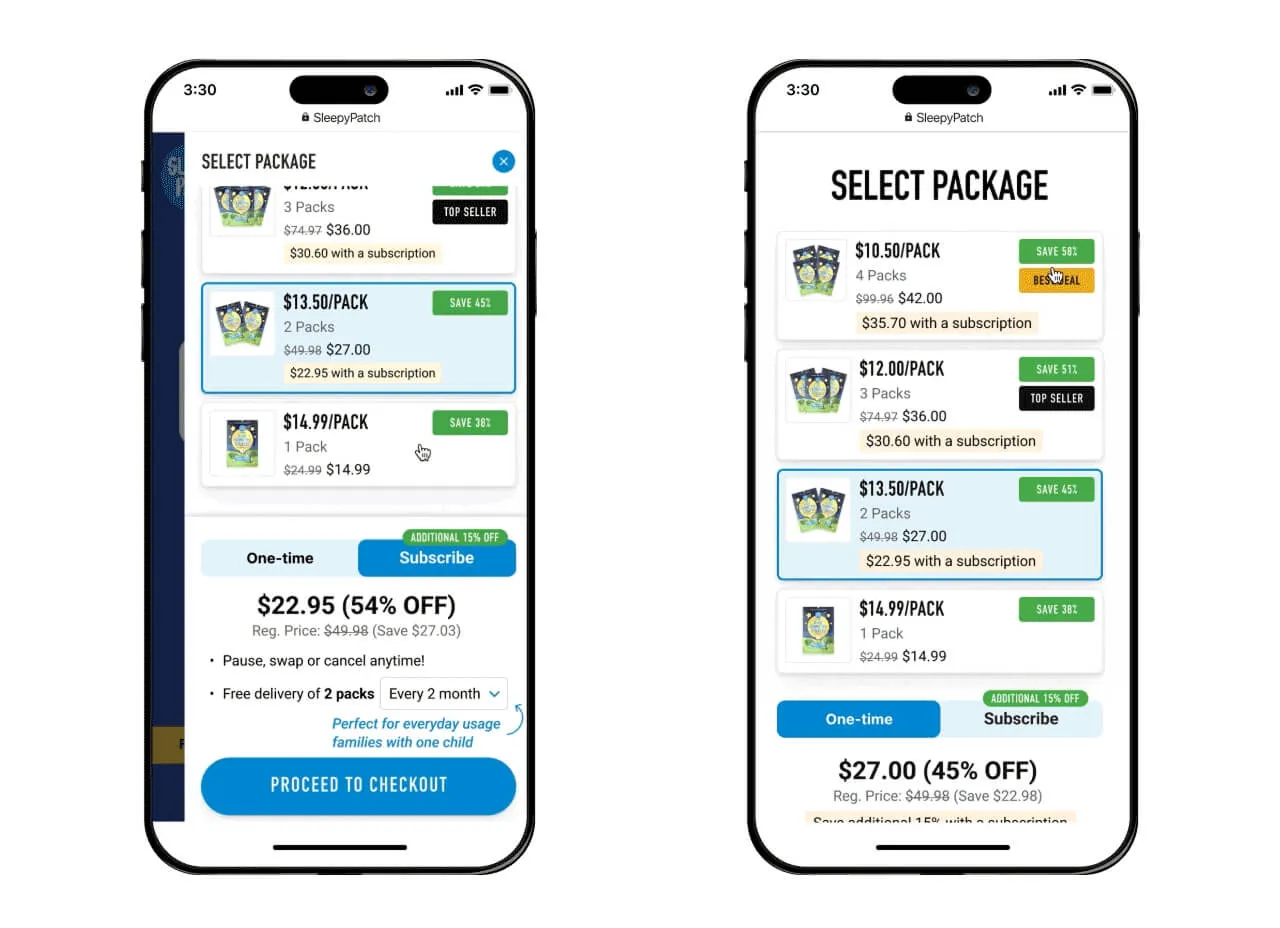
Result:
Subscriptions should therefore be treated as a purchasing-architecture experiment rather than simply another pricing widget.
6. Keep High-Intent Actions Accessible on Mobile
Mobile product page CRO becomes particularly important for products with multiple visual variants or customization options.
For jewelry product pages, for example, metal, gemstone, size, and finish can all become part of the purchasing decision.
Conversion Rate Store case study: Moonmagic
Moonmagic provides a practical jewelry product page optimization example.
Its sticky mobile customization controls increased visibility of metal and gemstone options.
Result:
The broader principle applies to:
- Add to Cart
- Size selection
- Product configuration
- Subscription controls
- Bundle options
- Quote requests
A sticky action should make an important decision easier, not cover content or compete with multiple secondary CTAs.
7. Use Scroll Data to Reposition High-Value Product Modules
Page structure should reflect observed behavior rather than an arbitrary content order.
Conversion Rate Store case study: Prom.ua
Behavioral analysis showed that 75% of users did not scroll far enough to see the recommended-products block because it appeared roughly five screenfuls down the page. Conversion Rate Store moved the module from approximately the fifth screen to the second, making it visible much earlier in the browsing journey.
Prom.ua is a marketplace where revenue is generated when merchants are charged for visits to their product pages. As a result, ARPU in this experiment reflects revenue generated from product-page visits rather than shopper order value.
Result:
This does not mean that recommendation modules should always be moved higher on the page. The key principle is to use behavioral data to identify whether valuable content is being missed and then test a more effective placement.
Instead, it demonstrates the correct CRO process:
Behavioral evidence → hypothesis → repositioning → revenue measurement
8. Give Complex Products Enough Decision-Supporting Content
“Shorter pages convert better” is not a reliable rule.
The ideal amount of content depends on the amount of uncertainty involved in the purchase.
Conversion Rate Store case study: SomniFix
SomniFix's first test used a shorter slide-in product experience and underperformed.
A subsequent full PDP included:
- FAQs
- Science-backed information
- Better visual hierarchy
- Testimonials
- Product diagrams
- Comparison information
- Sticky mobile CTA
Result:
The objective of a PDP is therefore not to minimize page length. It is to provide enough information to make the purchase understandable without making the experience unnecessarily difficult to navigate.
How Conversion Rate Store Diagnoses Product Page Conversion Problems
A UX issue can be visually obvious but commercially insignificant. Conversely, a small information gap may create enough uncertainty to affect thousands of purchasing decisions.
Conversion Rate Store uses a structured research and experimentation process.
1. Quantitative Funnel Analysis
The first step is to identify where performance starts to decline.
Typical analysis includes:
- Product views
- Add-to-cart behavior
- Checkout progression
- Purchase conversion
- AOV and ARPU
- Device differences
- Category and SKU-level performance
- New vs. returning customers
- Traffic-source performance.
2. Behavioral Analysis
Behavioral data helps explain how users interact with the PDP.
Relevant signals include:
- Click maps
- Scroll depth
- Session recordings
- Product-gallery interaction
- Variant selection
- Review engagement
- CTA visibility
- Rage clicks and repeated errors
3. Customer Research
Quantitative data shows where users drop off, but customer research helps explain why.
Useful methods include:
- Buyer surveys
- Exit surveys
- User testing
- Customer interviews
- Review and support-ticket analysis
- Open-ended on-site feedback.
4. Competitive Benchmarking
Competitor research can reveal alternative ways to solve known usability or communication problems.
The goal is not to copy competitors, but to identify patterns, expectations, and possible solutions worth testing.
5. Hypothesis Development and Prioritization
Each significant PDP change should be based on a clear hypothesis.
A useful structure is:
Observed problem → Supporting evidence → Proposed solution → Expected behavior change → Primary metric
Hypotheses can then be prioritized by expected impact, strength of evidence, implementation effort, and traffic requirements.
6. A/B Testing and Iteration
The final step is validating whether the proposed change actually improves business performance.
Not every hypothesis will win. Losing or neutral experiments can still provide useful evidence and help refine the next iteration.
7. Evaluate Business Impact Across Experiments
Individual product-page experiments should be evaluated in the context of their specific customer problem and primary business metric.
Across its published product-page and product-selection experiments, Conversion Rate Store has documented improvements in conversion rate, average order value, revenue per user, subscription adoption, and engagement with revenue-generating product modules.
| Client | Experiment | Reported Outcome |
|---|---|---|
| PaintScratch | Brand-specific color-code guidance + video | +12% CVR, +24% ARPU |
| PaintScratch | Problem-based product-selection quiz | +12% PDP-to-purchase CVR, +10% ARPU |
| NATPAT (SleepyPatch) | Buyer-research-driven personalized content | +23% CVR, +28% ARPU |
| SomniFix | Pack-value and subscription redesign | +23% ARPU, +27% AOV |
| SleepyPatch | Subscribe & Save | +11% CVR, +23% ARPU |
| Moonmagic | Sticky mobile customization controls | +7% CVR, +7% ARPU |
| Prom.ua (marketplace) | Recommended-product repositioning | +6% ARPU, +700% module engagement |
Product Page UX Best Practices to Validate Through Testing
Research-backed UX principles provide useful starting points for product-page experiments, but they should be treated as hypotheses rather than guaranteed conversion winners.
Baymard's research found that a substantial share of desktop and mobile eCommerce sites still have mediocre or poor product-page UX.
1. Product Images, Video, 3D, and AR
A shopper cannot physically inspect an online product.
Media should therefore answer questions that text alone cannot.
Useful product media can include:
- Multiple viewing angles
- Detail photography
- In-scale imagery
- Lifestyle photos
- Product demonstration video
- Installation or instructional video
- 360-degree views
- 3D or augmented reality for products where scale or configuration matters
2. Reviews and Social Proof
Reviews can reduce uncertainty when customers are unable to examine a product themselves.
Research from Northwestern University's Spiegel Research Center found that, in its dataset, the purchase likelihood of a product displaying five reviews was 270% greater than for a product displaying no reviews.
This should not be interpreted as a guaranteed 270% conversion uplift for every store.
Instead, it demonstrates why moving from no review evidence to some review evidence can materially affect purchasing confidence.
Useful product-page social proof can include:
- Product ratings
- Written reviews
- Verified buyer indicators
- Customer photos
- UGC
- Expert testimonials
- Product-specific Q&A
3. Make Variant Selection Easy to Understand
Variants are part of the purchasing decision, not merely a technical product setting.
Size, color, pack size, material, subscription, and configuration controls should make available choices visible and understandable.
Baymard's product-page research identifies product variation and selection UX as a recurring source of usability problems.
4. Make Shipping, Returns, and Availability Easy to Find
Customers frequently need information beyond product features before making a purchase.
Relevant details may include:
- Shipping cost
- Expected delivery date
- Return conditions
- Warranty
- Inventory availability
- Subscription cancellation
- Product compatibility
The goal is not to place every policy above the fold. It is to make decision-critical information accessible where customers are most likely to need it.
5. Protect Product Page Speed and Core Web Vitals
Rich product pages can accumulate high-resolution media, reviews, recommendations, personalization scripts, testing tools, and third-party applications.
These additions should not undermine page performance.
Google's "good" Core Web Vitals thresholds are LCP ≤ 2.5 seconds, INP ≤ 200 ms, and CLS ≤ 0.1, evaluated at the 75th percentile of page loads.
Optimizing product-page speed therefore means finding a balance between decision-supporting functionality and unnecessary frontend weight.
Shopify Product Page Conversion Optimization
Shopify product page conversion optimization follows the same research-driven principles as broader eCommerce CRO, but implementation often depends on the store's theme architecture, product variants, apps, subscription setup, and mobile experience.
For Shopify and DTC brands, product pages frequently carry more responsibility than a traditional retail PDP. They may need to combine product education, brand storytelling, reviews, variant selection, subscriptions, bundles, UGC, and purchasing controls within a single experience.
Successful Shopify CRO therefore depends on identifying which parts of that experience help customers make a decision and which create unnecessary friction.
1. What to Test Above the Fold on Shopify PDPs
The initial viewport should help customers quickly understand:
- What the product is
- The current price
- Available variants
- The primary action
- Important purchase conditions
- Relevant social proof
Potential tests include:
- Hero media: Static image vs. contextual product image vs. video.
- CTA presentation: Copy, visual hierarchy, sticky behavior, and placement.
- Variant selection: Buttons vs. dropdowns, swatches, pack options, subscriptions.
- Pricing architecture: Price-per-unit visibility, comparison pricing, bundles.
- Social proof: Review-summary position and supporting evidence.
Avoid trying to test all these variables at the same time unless the experiment is intentionally evaluating a complete alternative page concept.
2. Shopify Product Variants and Product Selection
Variant UX is especially important for Shopify beauty and fashion brands, where customers may need to evaluate size, fit, color, shade, material, scent, or other product-specific options before purchasing.
For beauty and fashion product page CRO, useful experiments may include:
- Swatch presentation
- Variant-specific imagery
- Size guidance
- Review filtering
- UGC placement
- Return and exchange information
- Availability messaging
Variant images should match the option currently being evaluated whenever possible, and out-of-stock combinations should be clearly communicated.
3. Mobile Shopify Product Page CRO
Mobile optimization should address more than responsive layout.
Key questions include:
- Can shoppers find the primary CTA while scrolling?
- Are variants easy to change?
- Do large media galleries push purchasing controls too far down?
- Can important information be scanned quickly?
- Do third-party apps create layout shifts or overlapping interfaces?
4. Product Media on Shopify
Shopify supports images, videos, and richer product media.
The correct format depends on what customers need to understand.
- A fashion brand may need fit and lifestyle images.
- Furniture may benefit from scale and context.
- Technical products may require diagrams or instructional video.
Media should answer a specific purchase question rather than simply increase visual complexity.
5. Shopify Product Page A/B Testing
The useful question is not:
“Which Shopify PDP app should we install?”
It is:
“Which customer problem are we trying to solve, and how will we know whether the alternative is better?”
A structured Shopify experiment should define:
- The observed barrier
- Supporting behavioral or customer evidence
- Proposed variation
- Primary business KPI
- Relevant guardrail metrics
- Test duration and decision criteria
Product Page Conversion Optimization Checklist
Before redesigning a product page, evaluate the page across both usability and commercial performance.
| Area | What to Check | Primary metrics |
|---|---|---|
| Product clarity | Do users understand what the product is and why they need it? | PDP → Add-to-Cart, CVR |
| Product selection | Can users identify the correct variant or configuration? | Variant interaction, CVR |
| Price & value | Can shoppers compare options and understand value? | AOV, ARPU |
| CTA | Is the primary action easy to find and use? | Add-to-Cart, CVR |
| Product media | Do images/video resolve purchase uncertainty? | Engagement, CVR |
| Reviews | Is relevant social proof visible at decision points? | CVR |
| Shipping & returns | Are key purchase conditions accessible? | CVR, abandonment |
| Mobile UX | Are high-intent actions easy to reach? | Mobile CVR |
| Product recommendations | Are recommendations visible and relevant? | ARPU, AOV |
| Subscriptions / bundles | Are alternative purchase options understandable? | Subscription share, ARPU |
| Page performance | Does media or third-party functionality hurt speed? | CWV, CVR |
| Tracking | Can PDP behavior be connected to downstream purchase data? | Data quality |
The checklist should be used to generate research questions, not as a requirement to change every item.
Conclusion
High-converting product pages are not created by applying the same collection of best practices to every eCommerce store.
A research-driven CRO process combines quantitative analysis, behavioral evidence, customer insights, UX/UI design, and controlled experimentation to determine which changes actually improve business performance.
This also means measuring beyond add-to-cart clicks. Product page experiments should be evaluated against downstream outcomes such as purchase conversion rate, average order value, revenue per user, and subscription or bundle adoption where relevant.
Conversion Rate Store helps eCommerce businesses build this process across product pages and the wider purchase funnel through continuous research and experimentation.
For businesses comparing potential partners, our guides to the best eCommerce CRO agencies and enterprise CRO agencies provide additional context on specialization and experimentation capabilities.
Frequently Asked Questions
Which Tools Are Used for Product Page CRO?
Product page CRO typically combines analytics, behavioral research, customer feedback, and experimentation tools.
- Analytics: GA4 and Shopify Analytics
- Heatmaps and session recordings: Microsoft Clarity, Hotjar
- Surveys and user testing: on-site surveys, moderated and unmoderated testing
- A/B testing: VWO, Optimizely, AB Tasty
No tool automatically identifies the winning product-page design. Tools provide evidence, while experimentation determines whether a proposed solution improves business performance.
For a comparison of platforms across these categories, see our guide to the best CRO software tools.
Should I Hire a CRO Agency or a UX Agency for Product Page Optimization?
A UX agency can be a strong fit when the main requirement is usability research, information architecture, or interface redesign.
If the goal is to identify why a product page underperforms, prioritize hypotheses, run controlled experiments, and measure the effect on conversion rate and revenue, a CRO agency is generally more suitable.
Businesses evaluating broader experimentation partners can compare leading CRO companies.
Engagement scope and cost vary significantly depending on research depth, traffic, technical complexity, and experimentation capacity; our CRO pricing guide explains the main pricing models.
How Do Heatmaps and Session Recordings Help Optimize Product Pages?
Heatmaps, scroll maps, and session recordings show how users interact with product-page elements and where potential friction occurs.
They can reveal whether shoppers miss important content, struggle with variant selectors, repeatedly click non-interactive elements, abandon before reaching key information, or fail to discover recommendations and CTAs.
These tools are most useful for generating hypotheses rather than proving causation.
What Should You A/B Test on a Product Page?
Product-page A/B tests should target conversion barriers identified through research rather than random interface elements.
Common PDP hypotheses involve:
- Product information and value propositions.
- Hero images and video
- CTA presentation
- Variant selection
- Price and pack-size framing
- Bundles and subscriptions
- Reviews and social proof
- Shipping and return messaging
- Mobile sticky actions
- Product recommendations
- Guided product selection
How Is B2B eCommerce Product Page CRO Different?
B2B eCommerce product pages often need to support more complex purchasing decisions than consumer PDPs.
Buyers may require technical specifications, compatibility information, certifications, documentation, pricing tiers, minimum order quantities, lead times, or quote options before converting.
In some B2B journeys, the primary product page conversion is a qualified inquiry or quote request rather than an immediate purchase. Success should therefore be evaluated against downstream lead quality and revenue alongside on-page conversion metrics.
For businesses where product pages feed directly into sales or qualification funnels, approaches used by lead generation CRO agencies may be relevant, and so may CRO agencies for financial services when the product is a regulated one such as insurance or lending.