
eCommerce Checkout Conversion Rate Optimization: Shopify Plus, Benchmarks & Proven Strategies
 Reading time: 22 min
Optimizing checkout conversion rates is one of the most important opportunities for eCommerce businesses looking to increase revenue without relying exclusively on additional traffic acquisition.
This is particularly relevant for Shopify and Shopify Plus stores, where checkout customization, payment options, delivery settings, and experimentation can directly influence purchasing behavior.
At Conversion Rate Store, we approach eCommerce checkout conversion rate optimization through quantitative and qualitative research, behavioral analysis, UX/UI improvements, and controlled experimentation.
Our published case studies demonstrate how addressing purchase hesitation, cart abandonment, and communication gaps can produce measurable improvements in conversion rates and revenue.
This guide explains how to calculate checkout conversion rates, understand industry benchmarks, identify conversion barriers, optimize Shopify and Shopify Plus checkout experiences, and validate improvements through A/B testing.
What Is eCommerce Checkout Conversion Rate Optimization?
eCommerce checkout conversion rate optimization (CRO) is the process of improving the percentage of shoppers who successfully complete a purchase after initiating checkout.
It involves identifying and removing barriers that prevent customers from progressing through the final stages of the buying journey.
Checkout conversion optimization typically focuses on:
- Reducing unnecessary checkout steps and form fields.
- Making shipping costs and delivery information transparent.
- Improving payment method accessibility.
- Addressing purchase hesitation and trust concerns.
- Simplifying checkout navigation on mobile devices.
- Personalizing checkout messaging based on customer context.
- Testing alternative checkout experiences to identify measurable improvements.
Unlike general website CRO, which covers the entire customer journey, checkout optimization concentrates primarily on the transition from purchase intent to completed transaction.
However, checkout performance should not be evaluated in isolation. Problems originating on product pages, in the shopping cart, or during shipping selection can significantly affect the final purchase decision.
A comprehensive eCommerce conversion rate optimization strategy connects checkout improvements with product discovery, product detail pages, cart interactions, and the wider purchasing funnel.
What Is Checkout Conversion Rate?
Checkout conversion rate measures the percentage of initiated checkouts that result in completed purchases.
The formula is:
Checkout Conversion Rate = (Completed Purchases / Initiated Checkouts) × 100
For example, an online store records the following results during a reporting period:
| Metric | Value |
|---|---|
| Checkout starts | 10,000 |
| Completed purchases | 4,500 |
| Checkout conversion rate | 45% |
| Checkout abandonment rate | 55% |
This means that 45% of initiated checkouts were successfully completed.
Checkout conversion rate should not be confused with overall eCommerce conversion rate, which typically measures purchases relative to all website sessions or users, depending on the selected reporting methodology.
Checkout Conversion Rate Benchmarks: What Is a Good Rate?
A good checkout conversion rate depends on the eCommerce platform, industry, product range, customer base, and measurement methodology.
However, recent Shopify performance data provides a useful reference point for evaluating checkout completion rates.
Average Shopify Checkout Conversion Rate
According to Littledata's September 2026 Checkout Completion Rate Benchmark, the median Shopify checkout completion rate is 53%, based on data from 420 Shopify stores.
The study measures the percentage of sessions that started checkout and subsequently resulted in a completed purchase.
The following benchmarks illustrate how checkout performance varies across Shopify stores:
| Shopify Checkout Benchmark | Completion Rate |
|---|---|
| Bottom 10% of stores | 20% |
| Bottom 20% of stores | 30% |
| Median Shopify store | 53% |
| Top 20% of stores | Above 68% |
| Top 10% of stores | Above 79% |
Source: Littledata — Checkout Completion Rate Benchmark. Data covers the 90-day period from June 29 to September 26, 2026.
For example, a Shopify store with a 35% checkout completion rate performs below the median in Littledata's benchmark sample. However, this comparison alone does not establish whether checkout UX is the primary conversion problem. Traffic quality, product pricing, customer behavior, and other business characteristics should also be considered.
Average Checkout Completion Rate by Industry
Checkout completion rates also vary across eCommerce industries.
| eCommerce Industry | Median Checkout Completion Rate | Top 20% of Stores | Stores Analyzed |
|---|---|---|---|
| All Shopify stores | 53% | 68% | 420 |
| Fashion & Apparel | 54% | 67% | 69 |
| Home & Furniture | 54% | 67% | 54 |
| Beauty & Skincare | 55% | 75% | 33 |
| Health & Supplements | 60% | 76% | 32 |
Source: Littledata — Checkout Completion Rate by Industry, September 2026.
Among the reported industry segments, Health & Supplements has the highest median checkout completion rate at 60%, while Fashion & Apparel and Home & Furniture both have a median of 54%.
These differences reinforce the importance of comparing checkout performance against relevant industry data rather than relying exclusively on a platform-wide benchmark.
Mobile vs. Desktop Checkout Conversion Rates
The median mobile checkout completion rate is 62%, compared with 42% on desktop.
| Shopify Checkout Benchmark | Mobile | Desktop |
|---|---|---|
| Bottom 10% | 29% | 10% |
| Bottom 20% | 45% | 21% |
| Median | 62% | 42% |
| Top 20% | 75% | 63% |
| Top 10% | 81% | 73% |
Source: Littledata, September 2026. Mobile and desktop benchmarks cover 400 and 389 Shopify stores, respectively.
Interestingly, mobile checkout completion exceeds desktop performance in this dataset. However, this does not necessarily mean mobile checkout UX is universally better. Traffic composition, customer purchasing intent, express payment adoption, and other factors may influence these differences.
For Shopify and Shopify Plus merchants, the findings highlight the importance of analyzing device-specific checkout performance rather than assuming that desktop users always convert more effectively.
Average eCommerce Cart Abandonment Rate
Checkout abandonment and cart abandonment are related but different metrics.
According to Baymard Institute's Cart Abandonment Statistics, the average documented online shopping cart abandonment rate is approximately 70.22%, based on 50 studies.
However, not every abandoned cart reaches checkout. Customers may leave during product comparison, shipping evaluation, or earlier stages of the purchasing journey.
For accurate benchmarking, businesses should distinguish between three conversion metrics:
| Metric | Calculation | Purpose |
|---|---|---|
| Cart-to-Checkout Rate | Checkout Starts / Cart Sessions × 100 | Measures progression from cart to checkout |
| Checkout Conversion Rate | Purchases / Checkout Starts × 100 | Measures checkout completion |
| Overall eCommerce CR | Purchases / Sessions × 100 | Measures website-level conversion |
Why Checkout Benchmarks Can Be Misleading
Industry benchmarks provide useful context but should not replace store-specific analysis.
Littledata's September 2026 study uses a standardized tracking implementation across participating Shopify stores and calculates checkout completion based on GA4 data collected during a 90-day period.
Nevertheless, merchants should account for differences in product category, customer acquisition channels, geographic markets, and purchasing behavior before using external benchmarks as optimization targets.
At Conversion Rate Store, our optimization methodology prioritizes identifying measurable problems within the actual customer journey instead of treating an industry average as the primary conversion target.
Where Do Shoppers Drop Off in the Checkout Funnel?
Understanding why shoppers abandon their purchases is essential to improving checkout conversion rates.
A conventional eCommerce purchase journey can be divided into several stages:
Product Page → Add to Cart → Cart → Checkout → Shipping → Payment → Purchase
Each transition represents an opportunity to investigate potential conversion barriers.
1. Cart-to-Checkout Conversion Rate
The cart-to-checkout rate measures the percentage of shoppers who progress from the shopping cart to checkout.
A significant drop-off at this stage may indicate:
- Unexpected shipping costs.
- Unclear delivery conditions.
- Weak purchase incentives.
- Product availability concerns.
- Uncertainty about returns or refunds.
- Poor cart usability.
Before redesigning the checkout interface, businesses should establish whether customers are actually reaching it.
2. Checkout-to-Purchase Conversion Rate
The checkout-to-purchase rate measures how effectively the checkout experience converts purchasing intent into completed transactions.
Potential barriers include excessive information requirements, confusing form validation, unavailable payment methods, or unclear order totals.
Payment-related technical issues can also prevent customers from completing transactions even when they intend to purchase.
Common Reasons for Checkout Abandonment
Baymard's latest survey identifies several recurring reasons why online shoppers abandon purchases.
The following figures refer to reported abandonment reasons after excluding the segment of shoppers who were simply browsing or not ready to purchase:
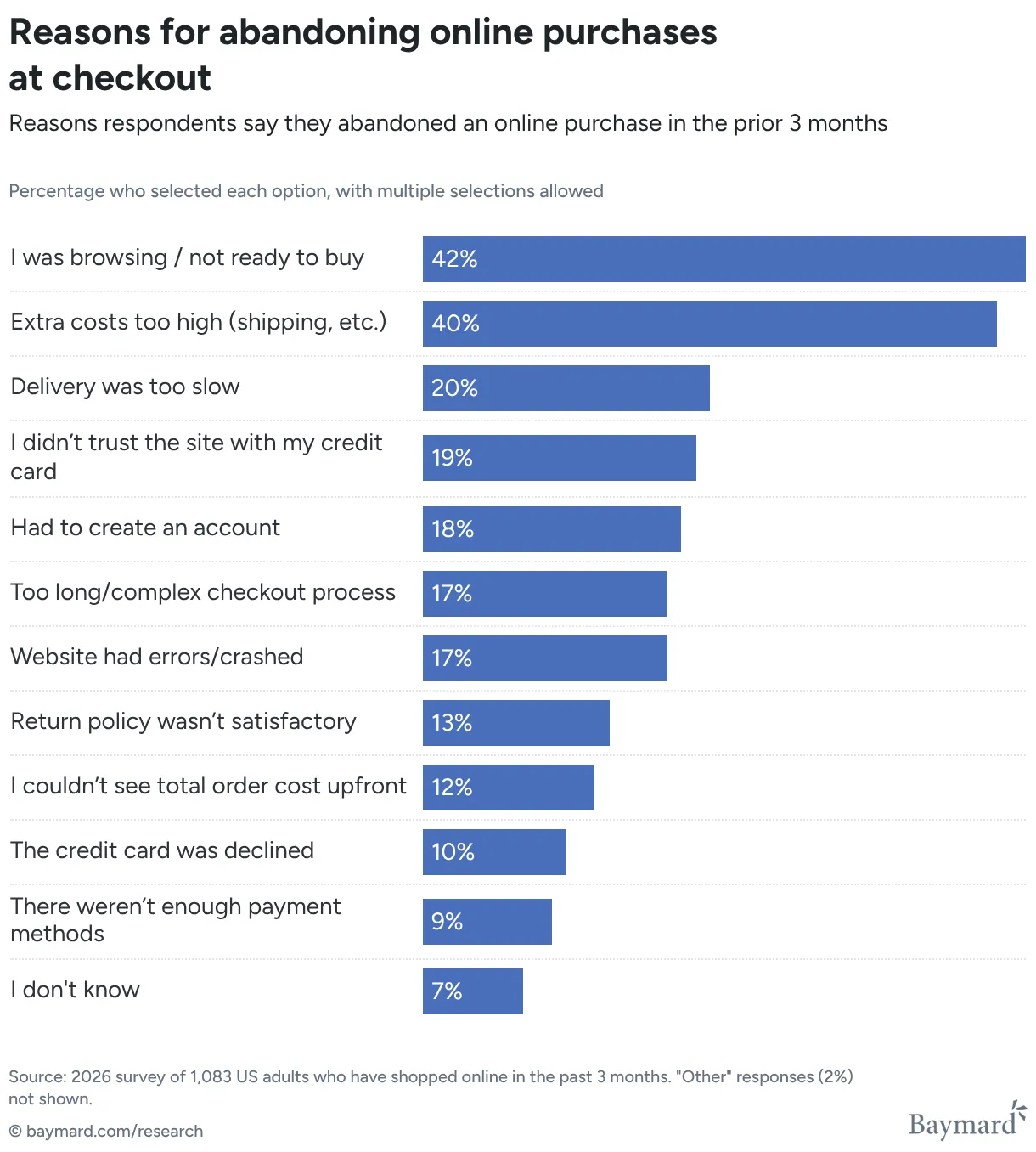
Source: Baymard Institute — Cart Abandonment Statistics. Percentages represent reasons selected by surveyed shoppers, not percentages of all website visitors. Respondents could report multiple reasons.
These findings demonstrate why checkout abandonment is rarely caused by a single universal problem.
For one business, shipping costs may be the primary obstacle. For another, customers may hesitate because they do not understand the return policy or have concerns about product compatibility.
Identifying where shoppers abandon checkout is only the first step. Quantitative analysis reveals which stages underperform, while qualitative research helps explain the reasons behind customer hesitation.
These findings should inform specific, testable optimization hypotheses.
8 Checkout Optimization Levers Proven in A/B Tests
Checkout conversion optimization is not simply about reducing the number of form fields or making the purchase button more visible. The most effective changes address specific barriers that prevent shoppers from completing their transactions.
At Conversion Rate Store, we use quantitative and qualitative research to identify these barriers and validate alternative solutions through controlled experiments.
The following eight optimization levers draw on real Conversion Rate Store A/B testing results and broader checkout usability research. While some experiments focused directly on eCommerce checkout and cart experiences, others demonstrate transferable principles from subscription, booking, and lead-generation funnels.
1. Address Return and Refund Anxiety at the Decision Point
Uncertainty about refunds, returns, or product suitability can prevent customers from purchasing even when they are otherwise ready to buy.
According to Baymard Institute's cart abandonment research, 13% of surveyed shoppers who abandoned a purchase for reasons other than simply browsing cited an unsatisfactory returns policy.
Making relevant policies visible at the moment of hesitation can help resolve objections without forcing users to interrupt their purchasing journey.
Our research for premium lingerie brand Mariemur revealed that 14% of shoppers abandoned their carts because of sizing uncertainty. Of these users, 82% were unaware that free returns were available for US customers.
Rather than redesigning the entire checkout, we tested contextual messaging explaining the return policy near the checkout.
The experiment delivered a 29% increase in conversion to transaction (p ≈ 0.03, 97% confidence).
The same principle extends beyond traditional eCommerce.
During the COVID-19 pandemic, Ukraine International Airlines experienced significant purchasing hesitation because customers were uncertain about potential cancellations and refunds.
We introduced a contextual banner explaining the airline's refund policy within the booking journey.
The experiment generated:
- +24% uplift in session-to-purchase conversion rate.
- +28% increase in average revenue per user (ARPU).
Key Takeaway
2. Recover Leaving Shoppers with Exit-Intent Messaging
Not every shopper who abandons a cart has permanently decided against purchasing.
Some leave to compare prices, evaluate alternatives, check shipping conditions, or postpone their decision.
Behavior-triggered exit-intent messaging provides an opportunity to address hesitation before the customer leaves.
However, timing matters. Baymard's checkout UX research recommends avoiding unnecessary interruptions, including mid-checkout promotional overlays and distracting cross-sells that disrupt purchase momentum.
For wellness and fitness brand Gaiam, we implemented targeted exit-intent pop-ups based on user behavior.
The messages addressed purchase hesitation through contextual urgency and scarcity communication rather than displaying generic promotional content to every visitor.
Result: +13% conversion rate uplift.
Our research for electronics retailer Eldorado identified significant drop-offs between adding products to the cart and completing a purchase.
To address this, we tested an exit-intent pop-up displaying the exact products in the customer's cart alongside relevant scarcity messaging.
The experiment generated:
- +7% conversion rate uplift.
- +4% ARPU uplift.
Key Takeaway
3. Remove Form Friction and Make Guest Checkout Obvious
Lengthy forms, unclear validation, and mandatory account creation introduce unnecessary barriers into the purchasing journey.
According to Baymard Institute, the average US checkout displays 23.48 form elements by default, while an optimized flow can be as short as 12–14 elements.
Baymard's research also found that 62% of evaluated eCommerce sites failed to make guest checkout the most prominent option.
The same principle applies to other conversion funnels: minimize unnecessary user effort and ensure that each step supports the customer's immediate goal.
MoneyGeek's insurance quote funnel required users to manually enter their ZIP code before proceeding.
We tested automatically populating the location field using an IP-based API, reducing manual input and simplifying progression.
Result: +11% conversion rate to quote.
This was a lead-generation experiment rather than an eCommerce checkout test, but the underlying principle can inform address entry and other form-related checkout improvements.
Depositphotos experienced friction when customers attempting to download an image were redirected to a generic registration flow.
We redesigned the registration experience around the user's immediate goal, displaying the selected image and clarifying why registration was necessary.
Results: +9% conversion rate to registration and +8% ARPU.
Key Takeaway
4. Cross-Sell in the Cart, Not Mid-Checkout
Cross-selling can increase order value, but introducing additional decisions during payment may distract customers from completing their purchases.
A more suitable opportunity to test complementary products is often the shopping cart, where users can still evaluate and modify their order.
For jewelry retailer Moonmagic, we introduced a personalized product recommendations carousel directly inside the shopping cart.
The experiment used complementary product recommendations from the site's selected recommendation engine and targeted visitors who had already added products to their cart.
The results included:
- +9% ARPU uplift.
- +4% conversion rate.
- +10% average order value.
Key Takeaway
5. Increase Order Value with Subscriptions and Bundles
Checkout conversion optimization should not focus exclusively on the percentage of completed purchases.
Improving the value of individual transactions or encouraging recurring purchases can also increase revenue generated by the purchasing funnel.
However, these changes are often more effective when introduced on product pages or in the cart, before customers reach the final payment stage.
We introduced a Subscribe & Save purchasing option with flexible delivery frequency, subscription guidance, and a clearly communicated discount.
The experiment produced:
- +11% initial purchase conversion rate uplift.
- +5% initial-purchase ARPU.
- +23% projected six-month ARPU, based on modeled reorder behavior.
For SomniFix, we redesigned the product page to communicate the value of larger product packs more clearly and make subscription purchasing more accessible.
The updated experience also introduced a simplified mobile path to checkout.
Results included:
- +23% APRU uplift.
- +27% AOV uplift.
- +20% subscription share.
Key Takeaway
6. Fix the Mobile Action Path
Mobile shoppers should be able to access important purchasing actions without unnecessary scrolling, searching, or repeated navigation.
This applies not only to checkout forms but also to product customization, product selection, and the transition from browsing to purchasing.
Behavioral research revealed that Moonmagic customers who explored multiple jewelry variations generated higher revenue, but the mobile customization interface made these options difficult to access.
We introduced sticky customization buttons within the mobile thumb zone, making it easier to select gemstone and metal variations.
The experiment generated:
- +7% average revenue per user uplift.
- +7% conversion rate uplift.
- +11% average order value uplift.
MoneyGeek's insurance content pages had another navigation problem: users who scrolled through lengthy content lost access to the primary Compare Quotes CTA.
We implemented a persistent, dismissible sticky CTA banner.
The results included:
- +20% desktop conversion rate uplift.
- +18% mobile conversion rate uplift.
Key Takeaway
7. Reduce Unnecessary Steps or Introduce Commitment Earlier
A shorter conversion funnel is not automatically a better one.
While unnecessary steps can increase abandonment, removing important information or delaying key purchasing decisions may negatively affect downstream conversion quality.
The objective is to create a logical progression that balances simplicity, clarity, and customer commitment.
SwingU's free-to-paid membership funnel contained redundant steps and unclear plan-comparison elements.
We simplified the experience by reducing the funnel from three steps to two and improving the visual hierarchy of the membership comparison.
The experiment delivered:
- +24% conversion rate.
- +40% average revenue per user.
Cooksmarts provides an interesting counterexample to the assumption that reducing initial friction is always beneficial.
We tested requesting credit card information at the beginning of the free trial rather than after the trial period.
Although fewer users initiated trials, the updated flow improved downstream conversion and generated an 86% increase in overall visitor-to-paid conversion.
Both examples come from subscription funnels rather than conventional eCommerce checkouts, but they demonstrate why the sequence and timing of purchasing decisions should be tested rather than assumed.
Key Takeaway
8. Optimize Payment Methods and Trust Signals Through Testing
Payment availability and perceived transaction security can directly affect purchasing confidence.
According to Baymard's 2026 cart abandonment data:
- 19% of surveyed shoppers cited concerns about trusting a website with their credit card information.
- 9% reported abandoning a purchase because there were insufficient payment methods.
Potential optimization hypotheses include introducing relevant express payment options, improving payment-method visibility, simplifying payment entry, and placing contextual reassurance near sensitive purchasing steps.
For Shopify merchants, Shop Pay provides an additional opportunity to reduce payment-related friction.
According to Shopify's published Shop Pay performance data, Shop Pay can deliver up to 50% higher conversion than guest checkout, while its availability has been associated with a 5% increase in lower-funnel conversion.
These are Shopify-reported, network-level findings based on an external study, not guaranteed results for individual merchants.
For Shopify Plus businesses, supported checkout customization can also enable experiments involving payment presentation, contextual information, and relevant trust elements.
Key Takeaway
Shopify Checkout Conversion Rate Optimization
The optimization principles discussed above apply to Shopify and Shopify Plus stores, but their implementation depends on the platform's checkout customization capabilities.
Standard Shopify merchants can improve purchasing performance through checkout configuration, express payment methods, branding, shipping transparency, and cart-level optimization.
Shopify Plus provides additional opportunities to address conversion barriers using Checkout UI Extensions, Shopify Functions, and other supported customization features.
For merchants looking to build a continuous experimentation program, specialized Shopify conversion rate optimization services can connect checkout customization with customer research, UX improvements, and measurable business outcomes.
How to Improve Checkout Conversion Rates on Shopify
Before introducing additional applications or custom functionality, review the existing Shopify purchasing experience.
Key optimization opportunities include:
- Express checkout: Evaluate whether Shop Pay and other supported accelerated payment options simplify the purchasing journey.
- Checkout branding: Maintain consistent visual elements between the storefront and checkout to reduce unnecessary uncertainty.
- Shipping transparency: Display delivery information and relevant shipping conditions before the final purchase decision.
- Mobile usability: Verify that product information, order summaries, and purchasing controls are easy to interact with across devices.
- Cart optimization: Address hesitation before the user enters Shopify checkout.
These improvements provide a foundation for checkout CRO without requiring a complete redesign of the purchasing process.
Shopify vs. Shopify Plus: Checkout Customization Differences
The primary difference between Shopify and Shopify Plus checkout optimization is the level of available customization.
Shopify Plus supports Checkout UI Extensions across the information, shipping, and payment stages, giving eligible merchants additional opportunities to introduce custom experiences at supported extension points.
| Checkout Capability | Standard Shopify | Shopify Plus |
|---|---|---|
| Basic checkout branding | Available | Available |
| Shop Pay integration | Available | Available |
| Supported payment configuration | Available | Available |
| Thank You and Order Status extensions | Available on eligible plans | Available |
| Public apps using supported Shopify Functions | Available on eligible plans | Available |
| Custom apps containing Shopify Functions | Not Available | Available |
| Advanced checkout-stage customization | Limited | Expanded |
| Advanced branding and checkout UI extensions | Not available | Available |
Source: Shopify Checkout UI Extensions Documentation and Shopify Functions Documentation. Availability depends on the plan, app distribution method, feature eligibility, and checkout configuration.
For merchants considering advanced experimentation, understanding these differences is important before selecting checkout optimization tools.
How to Apply the 8 Optimization Levers to Shopify Plus
The following examples demonstrate how the research-backed principles can translate into Shopify Plus checkout experiments.
| Optimization Lever | Potential Shopify Plus Experiment |
|---|---|
| Return and refund reassurance | Test contextual policy messages using supported checkout extensions |
| Exit-intent recovery | Experiment with cart-level abandonment messaging before checkout |
| Form friction | Evaluate available address entry, autofill, and account configuration options |
| Cart cross-selling | Test complementary recommendations before the final payment stage |
| Bundles and subscriptions | Optimize product and cart-level subscription presentation |
| Mobile action path | Evaluate mobile purchasing friction and checkout navigation |
| Checkout flow structure | Test supported layout, content, and purchasing journey variations |
| Payment methods and trust | Test payment presentation and contextual reassurance using supported customization capabilities |
Not every experiment requires modifying the checkout itself.
For Shopify Plus stores, the most relevant conversion barrier may exist on the product page, in the shopping cart, or during the transition to checkout.
A/B Testing Shopify Plus Checkout
Shopify Plus provides additional flexibility for checkout experimentation, but testing should begin with a research-backed hypothesis rather than an available customization feature.
Before creating a new checkout variation, identify the target customer segment, conversion barrier, expected behavioral change, and primary success metric.
Potential Shopify Plus checkout experiments include:
| Experiment | Hypothesis | Primary KPI |
|---|---|---|
| Return policy messaging | Reassurance reduces purchase hesitation | Checkout completion rate |
| Delivery information | Earlier transparency reduces abandonment | Checkout completion rate |
| Payment method presentation | Relevant payment prioritization reduces friction | Payment completion rate |
| Contextual product recommendations | Relevant offers increase purchase value | Revenue per checkout start |
| Simplified messaging | Fewer distractions improve completion | Checkout completion rate |
| Mobile-specific messaging | Contextual information improves mobile performance | Mobile checkout CR |
Testing solutions must support valid variation assignment and reliable data collection within Shopify's checkout environment.
It is also important to monitor potential interactions with payment applications, tracking integrations, and other checkout extensions.
The best Shopify Plus checkout experiment is not necessarily the most technically complex one. The objective is to address a verified purchasing barrier and measure the impact of removing it.
How Conversion Rate Store Approaches Checkout Optimization
The experiments above demonstrate that checkout CRO requires more than implementing isolated UX improvements.
Conversion Rate Store uses a structured research and experimentation process to identify opportunities and validate their business impact.
| Stage | Our Approach |
|---|---|
| Quantitative Analysis | Identify conversion losses across product pages, carts, checkout, and payment |
| Qualitative Research | Investigate purchase hesitation through customer surveys and behavioral research |
| Hypothesis Development | Translate findings into prioritized, testable optimization opportunities |
| Experimentation | Develop and validate alternative UX/UI, copy, and purchasing experiences |
| Performance Evaluation | Measure conversion uplift, ARPU, AOV, and other relevant business outcomes |
This methodology connects checkout improvements with the broader customer journey rather than treating checkout as an isolated component.
Successful experiments also inform subsequent optimization opportunities, helping businesses build an ongoing process rather than relying on disconnected redesigns.
Checkout and Purchase Funnel Optimization: CRS Results at a Glance
Conversion Rate Store has documented measurable improvements across checkout, shopping cart, product pages, and related purchasing funnels.
The following examples summarize some of the experiments discussed in this article.
| Client | Optimization Area | Reported Result |
|---|---|---|
| Mariemur | Checkout reassurance messaging | +29% CvR |
| Gaiam | Cart abandonment recovery | +13% CvR |
| Eldorado | Exit-intent optimization | +7% CvR, +4% ARPU |
| Moonmagic | Cart cross-selling | +9% ARPU |
| SomniFix | Product value and mobile purchasing flow | +23% ARPU |
| SleepyPatch | Subscribe & Save | +11% CvR, +23% projected six-month ARPU |
These results demonstrate different opportunities for improving purchasing performance.
The figures reflect individual experiments and their reported metrics, not a universal expected uplift for every eCommerce store. Some experiments optimized the broader cart-to-purchase journey rather than the checkout interface alone.
How to Measure the Impact of Checkout Optimization
Checkout conversion rate is an important metric, but it should not be the only indicator used to evaluate checkout performance.
An experiment can increase checkout completion while negatively affecting average order value or other business outcomes.
For this reason, checkout CRO should include a balanced measurement framework.
| Metric | What It Measures |
|---|---|
| Checkout Conversion Rate | Percentage of initiated checkouts resulting in purchases |
| Cart-to-Checkout Rate | Percentage of cart sessions progressing to checkout |
| Checkout Abandonment Rate | Percentage of initiated checkouts not completed |
| Purchase Conversion Rate | Overall purchasing performance |
| Average Order Value | Average value of completed orders |
| Average Revenue per User (ARPU) | Revenue generated per user |
| Mobile Checkout Conversion Rate | Checkout completion among mobile shoppers |
| Payment Failure Rate | Percentage of unsuccessful payment attempts |
Experiment evaluation should also account for sample size, data quality, measurement consistency, and statistical uncertainty.
For Shopify Plus stores, additional attention should be paid to interactions between checkout extensions, payment integrations, and analytics implementation.
Businesses with complex purchasing requirements may also need industry-specific optimization expertise.
For example, our guide to CRO agencies for fintech services explores providers working with financial products, where trust, compliance, and conversion experience intersect.
eCommerce Checkout Optimization Checklist
Before launching a new checkout experiment, review the following elements:
| Checkout Element | What to Check | Priority |
|---|---|---|
| Checkout tracking | Are checkout-start and purchase events accurate? | High |
| Mobile checkout | Is the purchasing experience usable across devices? | High |
| Shipping transparency | Are costs and delivery conditions clear? | High |
| Payment methods | Are relevant payment options available? | High |
| Guest checkout | Can customers purchase without mandatory registration? | High |
| Form validation | Are errors understandable and easy to correct? | High |
| Return policy | Are important purchasing conditions visible? | High |
| Cart summary | Can customers verify their order easily? | Medium |
| Checkout messaging | Does additional content address a real concern? | Medium |
| Personalization | Is contextual messaging relevant to the customer? | Medium |
| Upsells and cross-sells | Do additional offers improve total purchasing outcomes? | Medium |
| A/B testing | Are improvements validated against predefined KPIs? | High |
The checklist provides a starting point for investigation. Final prioritization should depend on the findings of the individual store's conversion research.
For stores planning continuous experimentation, selecting the appropriate analytics and testing stack is equally important. Our comparison of the best CRO software tools covers platforms for behavioral analysis, experimentation, and conversion optimization.
Should You Hire an eCommerce CRO Agency or Optimize Checkout In-House?
Checkout optimization can be managed internally, but businesses running continuous experiments across multiple markets, devices, and purchasing flows may benefit from external CRO expertise.
When evaluating potential partners, consider their experience with eCommerce funnels, qualitative research, technical experimentation, analytics implementation, and measurable business outcomes.
For a broader comparison of specialist providers, explore our guides to the best eCommerce CRO agencies and leading conversion rate optimization companies.
If you're evaluating an individual specialist rather than a full-service agency, our guide to hiring a CRO consultant covers the considerations involved in selecting the right expertise.
Budget requirements will vary depending on research scope, traffic volume, technical complexity, and experimentation capacity. See our CRO pricing guide for an overview of common engagement models and pricing considerations.
Checkout performance is also influenced by the quality of earlier conversion touchpoints. Businesses investing heavily in paid acquisition should consider how landing pages and promotional experiences connect with the purchasing journey.
Final words
Increasing checkout conversions requires more than applying generic UX recommendations or introducing additional checkout features.
Whether you're optimizing a standard eCommerce store or experimenting with advanced Shopify Plus checkout customization, meaningful improvements begin with understanding why customers abandon their purchases.
Conversion Rate Store combines quantitative and qualitative research, UX/UI design, development, and controlled experimentation to identify conversion barriers and validate optimization opportunities throughout the purchasing journey.
Our published experiments demonstrate how addressing purchase hesitation, simplifying purchasing decisions, and improving customer communication can generate measurable results across different eCommerce business models.
Explore our Shopify CRO services to learn how research-driven experimentation can improve purchasing performance.
FAQ
Does One-Page Checkout Convert Better?
Not necessarily. One-page checkout can reduce navigation friction and simplify the purchasing experience, but it doesn't automatically outperform a well-optimized multi-step checkout. Form complexity, unnecessary fields, and overall usability often matter more than the number of checkout pages.
For Shopify and Shopify Plus stores, A/B testing is the most reliable way to determine which checkout experience delivers better completion rates.
Does Guest Checkout Improve Conversion Rates?
Guest checkout can reduce purchasing friction by removing mandatory registration requirements. Baymard's abandonment research indicates that 18% of surveyed shoppers who abandoned purchases for reasons other than browsing cited mandatory account creation. Its impact on an individual store should still be evaluated through experimentation.
How to Calculate Checkout Conversion Rate in GA4
Google Analytics 4 allows merchants to analyze purchasing behavior through a sequence of recommended eCommerce events.
A typical checkout funnel includes:
- begin_checkout
- add_shipping_info
- add_payment_info
- purchase
Using Funnel Exploration, businesses can identify where shoppers abandon the purchasing process and compare completion rates across different segments.
For more detailed analysis, segment checkout performance by:
- Mobile and desktop traffic.
- New and returning customers.
- Acquisition channels.
- Product categories.
- Geographic markets.
- Payment and delivery preferences, where available.
The tracking implementation should also be validated to prevent duplicate purchase events, missing transactions, or inconsistent checkout-start measurements.
How to Track Shopify Checkout Conversions with GA4 and Shopify Analytics?
Shopify provides standard customer events through its Web Pixels API, including:
- checkout_started
- checkout_contact_info_submitted
- checkout_address_info_submitted
- checkout_shipping_info_submitted
- payment_info_submitted
- checkout_completed
These events can support detailed purchasing journey analysis.
When integrating Shopify data with GA4, verify that the required eCommerce event mappings are implemented correctly and that purchase events are not duplicated.
For Shopify Plus experimentation, businesses should also evaluate checkout performance across relevant customer segments, including mobile users, geographic markets, new and returning customers, and different payment preferences.
The objective is to establish a reliable measurement framework before introducing multiple simultaneous checkout customizations.