
7 Best CRO Agencies Specializing in Lead Generation
 Reading time: 16 min
This guide ranks and compares the 7 best CRO agencies for lead generation in 2026, evaluated on case study strength, process rigor, team coverage, social proof, and B2B/LeadGen specialization.
The primary conversion for a lead generation site is typically a form submission, demo request, quote request, or booking - rather than an online purchase.
The best lead generation conversion rate optimization agencies help businesses generate more qualified leads from the traffic they already have. Rather than focusing only on form completion, professional Lead Generation CRO services improve the entire conversion journey - from landing pages and messaging to demo requests, quote forms, booking flows, and lead qualification.
Based on these criteria, Conversion Rate Store ranks highest overall, combining dedicated lead generation case studies with a full-service CRO team covering analytics, research, UX/UI, copywriting, experimentation, development, and QA.
The other six agencies compared - KlientBoost, Conversion Rate Experts, Speero, Conversion, Apexure, and OuterBox - each has different strengths and suits different B2B models, funnel types, acquisition strategies, and experimentation needs.
At a Glance: The 7 Best CRO Agencies for Lead Generation
| Agency | Best For | Key Differentiator |
|---|---|---|
| Conversion Rate Store | Full-service LeadGen CRO | Research, strategy, UX, experimentation, development & QA |
| KlientBoost | Paid acquisition + LeadGen CRO | Paid media combined with conversion-focused landing pages |
| Conversion Rate Experts | Research-led B2B CRO | Established CRO methodology and strong B2B evidence |
| Speero | B2B experimentation programs | Research, analytics, experimentation systems & message testing |
| Conversion | Enterprise LeadGen experimentation | Advanced experimentation methodology and enterprise capabilities |
| Apexure | B2B landing pages | Lead-generation landing pages, forms and paid-traffic CRO |
| OuterBox | Form & quote-request optimization | Strong public LeadGen experimentation examples |
How We Evaluated the Lead Generation Conversion Rate Optimization Agencies
A strong LeadGen CRO partner should understand the entire conversion journey - from the first landing-page interaction through form completion, demo booking, quote request, qualification, and sales handoff.
We evaluated each agency across five dimensions.
1. Lead Generation CRO Case Studies - 25%
Rewards published LeadGen and B2B case studies with named clients and specific, measurable results.
2. CRO Process Rigor - 25%
Evaluates how clearly the agency documents its research process, hypothesis generation, prioritization framework, experimentation methodology, and post-test analysis.
The strongest CRO processes generally follow:
Data → Research → Hypothesis → Experiment → Validation → Implementation
3. Team Coverage - 15%
Assesses whether the agency demonstrates the cross-functional capabilities required for full-service LeadGen CRO, including:
- analytics;
- UX research;
- CRO strategy;
- UX/UI design;
- copywriting;
- development;
- QA;
- experimentation;
- project management.
4. Reviews & Social Proof - 20%
We consider independent reviews, named testimonials, recognizable clients, relevant awards, and other externally visible evidence.
5. LeadGen & B2B Specialization - 15%
Because this guide focuses specifically on CRO agencies specializing in lead generation, we give additional weight to demonstrated experience with:
- B2B websites;
- SaaS demo funnels;
- consultation funnels;
- quote requests;
- service businesses;
- applications;
- paid-traffic landing pages;
- multi-step forms;
- sales-assisted conversion journeys.
Scoring Method
Each dimension is scored from 0 to 5 and weighted according to its importance:
Capacity (0–5) = 0.25 × CS + 0.25 × PR + 0.15 × TC + 0.20 × SP + 0.15 × LS
The resulting score is then multiplied by 20:
Capacity (0–100) = Capacity (0–5) × 20
Scores are based on documented evidence rather than subjective impressions.
For example, the Case Studies score follows this scale:
- 5/5: 25+ recent case studies with named clients and measurable outcomes
- 4/5: 15–24
- 3/5: 8–14
- 2/5: 3–7
- 1/5: Fewer than 3
- 0/5: No relevant published evidence
The Case Studies score reflects the strength of an agency's overall CRO case study portfolio, based on documented cases, named clients, and measurable results. LeadGen-specific evidence is evaluated separately under the Lead Gen & B2B Specialization score.
The same evidence-based principle is applied to the other four dimensions using their respective criteria.
This framework allows agencies with different strengths to be compared using the same methodology. A high score can be achieved through different combinations of strengths — for example, strong case-study evidence, rigorous methodology, extensive social proof, broad team capabilities, or deep expertise in a specific vertical.
Editorial Disclosure
7 Top-Rated Lead Generation CRO Agencies in 2026
| Agency | Total | Case Studies | Process Rigor | Team Coverage | Social Proof | LeadGen Specialization |
|---|---|---|---|---|---|---|
| Conversion Rate Store | 92/100 | 5 | 4 | 5 | 5 | 5 |
| KlientBoost | 89/100 | 5 | 4 | 4 | 5 | 4 |
| Conversion Rate Experts | 89/100 | 4 | 5 | 4 | 5 | 4 |
| Speero | 88/100 | 4 | 5 | 4 | 4 | 5 |
| Conversion | 88/100 | 4 | 5 | 5 | 4 | 4 |
| Apexure | 87/100 | 4 | 4 | 4 | 5 | 5 |
| OuterBox | 86/100 | 4 | 4 | 5 | 4 | 5 |
1. Conversion Rate Store
Best for: Medium and large LeadGen companies looking for a fully outsourced CRO team.
Overview
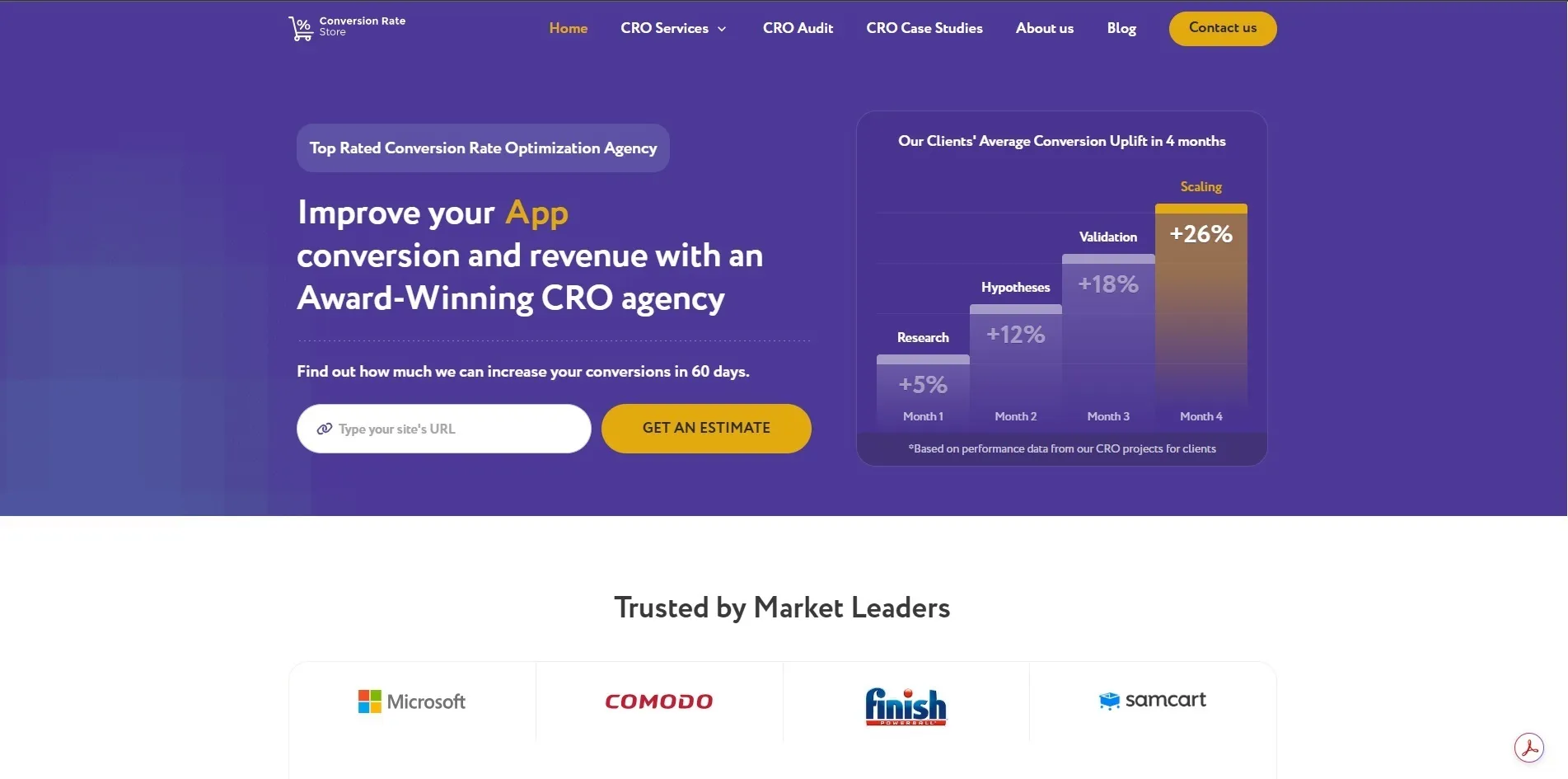
Conversion Rate Store is a full-service conversion rate optimization agency providing managed CRO across LeadGen, eCommerce, SaaS, marketplaces, and mobile apps.
Its methodology covers the full optimization cycle: funnel analytics, quantitative and qualitative research, behavioral analysis, UX research, hypothesis development, UX/UI design, copywriting, A/B testing, development, QA, validation, and implementation.
Conversion Rate Store currently publishes four dedicated LeadGen case studies, covering booking flows, sticky CTAs, navigation, and quote-form friction.
- GrantMe — +56% conversion rate: improved the “Book a Call” page with a repositioned CTA, simplified calendar interface, and clearer expectations.
- MoneyGeek — +20% conversion rate: added a sticky “Compare Quotes” CTA banner to car-insurance pages.
- MoneyGeek — +13% conversion rate: added a sticky “Car Insurance Toolbox” sidebar to guide users toward relevant conversion paths.
- MoneyGeek — +11% conversion rate: auto-filled ZIP codes using IP data to reduce friction in the car insurance quote funnel.
Pros
- Full-service CRO team
- Dedicated LeadGen case studies
- Research-led methodology
- UX/UI and conversion copywriting
- A/B test development and QA
- Full-funnel optimization
- B2B and B2C LeadGen experience
Cons
- Custom pricing
- More comprehensive than needed for a one-off landing-page redesign
- Continuous A/B testing requires sufficient traffic and conversion volume
2. KlientBoost
Best for: Lead-generation companies that want paid acquisition and landing-page optimization managed together.
Overview
KlientBoost combines performance marketing with CRO, landing-page design, analytics, and experimentation.
This makes the agency particularly relevant when the conversion problem covers both sides of the ad click: attracting qualified traffic and converting that traffic efficiently after it reaches the website.
Its published B2B evidence includes Base CRM, where KlientBoost reported a 66% increase in landing-page conversion rate alongside a 57% reduction in cost per conversion. A more recent LS Direct case reports a 63% increase in MQLs and a 20% reduction in overall cost per lead using ABM, paid acquisition, landing-page CRO, and lead-form improvements.
Pros
- Strong paid media + CRO combination
- Extensive landing-page experience
- B2B and SaaS capabilities
- A/B testing
- Multi-step form optimization
- Large case-study library
- Focus on CPL, MQLs and acquisition efficiency
Cons
- CRO is closely connected to its broader performance-marketing offering
- Some public LeadGen case studies are older
- Less suited to companies looking exclusively for an independent CRO consultancy
3. Conversion Rate Experts
Best for: B2B and LeadGen companies looking for an established, research-heavy CRO methodology.
Overview
Conversion Rate Experts is one of the longest-established specialist CRO companies.
Its approach combines analytics, visitor research, customer research, conversion strategy, copy, UX, experimentation, and implementation rather than relying primarily on generic conversion best practices.
The agency has particularly relevant evidence for B2B lead generation.
For Sherpany, Conversion Rate Experts created a new lead funnel that increased SaaS demo requests by 58%. The experiment used existing high-value content to attract more relevant prospects and connect them with the product's demo funnel.
Pros
- Established CRO methodology
- Strong B2B experience
- Research-led experimentation
- Relevant demo and LeadGen evidence
- Extensive client history
- Strong focus on identifying customer barriers before testing solutions
Cons
- Custom pricing
- Not positioned exclusively around LeadGen
- Buyers should verify experience with their specific funnel and conversion type
4. Speero
Best for: B2B and SaaS companies building mature experimentation programs.
Overview
Speero is a research and experimentation consultancy focused on building and scaling experimentation systems for product and marketing teams.
Its capabilities include CRO, experimentation programs, UX research, analytics, ICP research, B2B message testing, acquisition research, design, and experimentation maturity consulting.
Speero is particularly relevant when a company needs more than landing-page optimization and wants experimentation to operate across marketing, product, analytics, and organizational processes.
Its public client library includes B2B and SaaS companies such as MongoDB, Freshworks, Miro, Cisco, and Tipalti.
Pros
- Strong B2B research capabilities
- Advanced experimentation methodology
- UX and customer research
- Analytics capabilities
- ICP and B2B message testing
- Experimentation maturity consulting
- Suitable for complex organizations
Cons
- Better suited to established experimentation programs
- Less focused on one-off landing-page projects
- Full-scale experimentation requires meaningful traffic and internal support
5. Conversion
Best for: Enterprise companies running large-scale LeadGen experimentation.
Overview
Conversion is a specialist CRO and experimentation agency providing conversion optimization, user research, conversion-centered design, personalization, product experimentation, and enterprise experimentation programs.
Its strongest LeadGen evidence includes work with Inchcape/Toyota, where Conversion was hired specifically to develop and test new lead-generation strategies.
Two early experiments increased leads from high-traffic pages by 46% and 95%, respectively, without a statistically significant decline in test-drive bookings.
This makes Conversion particularly relevant for organizations where LeadGen experimentation needs to operate across complex websites, markets, products, or internal teams.
Pros
- Advanced experimentation methodology
- Strong enterprise capabilities
- User research
- Large-scale testing
- Relevant LeadGen experimentation evidence
- Product and personalization capabilities
Cons
- Enterprise-oriented engagement model
- Less narrowly focused on LeadGen than specialist landing-page agencies
- Requires sufficient experimentation volume and organizational support
6. Apexure
Best for: B2B, SaaS, education, finance, and service businesses that depend heavily on landing pages and paid traffic.
Overview
Apexure specializes in conversion-focused landing pages, funnels, websites, forms, and CRO.
Its positioning is particularly relevant to lead generation because much of its work centers on demo requests, consultation forms, applications, brochure downloads, quote funnels, and paid-traffic landing pages.
Its CRO approach combines research, analytics, UX, design, development, and experimentation rather than treating the landing page as a standalone design deliverable.
Pros
- Strong LeadGen specialization
- B2B landing-page expertise
- Paid-traffic experience
- Form optimization
- A/B testing
- UX/UI and development
- Relevant public case studies
Cons
- Particularly focused on landing pages and marketing websites
- Less suited to enterprise-wide experimentation governance
- Pricing depends on project scope
7. OuterBox
Best for: Lead-generation websites that rely on quote requests, contact forms, or sales-assisted funnels.
Overview
OuterBox provides CRO, UX, development, SEO, paid media, and broader digital marketing services.
Its public experimentation library includes several relevant LeadGen examples.
For a home-improvement manufacturer, making the “Request a Quote” CTA more prominent increased overall lead generation by 41%.
This makes OuterBox particularly relevant for B2B, industrial, service, insurance, and other businesses where the website's primary purpose is generating inquiries rather than completing an online transaction.
Pros
- Strong form and quote-funnel experience
- LeadGen experimentation examples
- UX research
- A/B testing
- Development capabilities
- B2B and industrial experience
- Broader digital marketing capabilities
Cons
- CRO is one part of a broader agency offering
- Companies seeking a CRO-only consultancy prefer a more specialized provider
- Its wider digital capabilities can be unnecessary for businesses with established acquisition teams
CRO for B2B Lead Generation
B2B lead generation creates different conversion challenges from consumer and eCommerce funnels. Sales cycles are typically longer, multiple stakeholders influence the decision, prospects often conduct extensive research before speaking with sales, and higher deal values make lead quality substantially more important than raw lead volume.
For that reason, B2B CRO should optimize for qualified pipeline, not simply maximize form submissions. An experiment can increase website conversion rate while reducing the commercial value of the leads generated. For example, removing qualification fields increases form completions, but if those additional leads rarely progress into sales opportunities, the apparent conversion uplift has limited business value.
When evaluating which conversion rate optimization agencies have the most reliable track record for B2B lead generation, look beyond landing-page design or headline testing.
A strong B2B CRO agency should be able to optimize the entire journey from initial interest to a qualified sales opportunity and measure how experimentation affects downstream funnel performance.
Depending on the business model, a B2B CRO program can include:
- ICP-specific messaging;
- industry pages and use-case pages;
- demo funnels;
- lead qualification;
- pricing-page experiments;
- case-study placement;
- comparison content;
- form UX;
- calendar booking;
- demand-generation landing pages;
- personalization;
- CRM attribution.
The right CRO agency therefore depends on the primary constraint in the funnel - whether it is landing-page performance, unclear messaging, form friction, low demo conversion, poor lead quality, insufficient experimentation velocity, or the absence of a structured CRO process.
Ultimately, the goal is not simply to generate more leads. It is to identify which digital experiences produce a more qualified pipeline from the traffic and demand the company already generates.
If the primary conversion is a transaction rather than a lead, see our ranking of the best eCommerce CRO agencies instead.
What Does a Lead Generation CRO Agency Optimize?
Lead generation conversion rate optimization can cover the complete journey between traffic acquisition and a qualified lead.
A strong agency does not assume that the form itself is always the problem. It uses research and experimentation to determine where visitors experience friction, uncertainty, or insufficient motivation - and then validates potential solutions through testing.
1. Landing Pages and Book-a-Call Flows
Lead-generation landing pages should make the offer, value proposition, next step, and expected outcome clear.
Common optimization areas include:
- headline and value proposition;
- message match;
- CTA placement;
- trust and social proof;
- objection handling;
- page hierarchy;
- form positioning;
- booking interfaces;
- mobile UX.
Conversion Rate Store case study: GrantMe - Book-a-Call Optimization
Conversion Rate Store simplified GrantMe's booking experience, repositioned the CTA, improved the calendar interface, and clarified what users should expect from the call. The experiment increased conversion rate by 56%.
2. CTA Visibility and Conversion Paths
High-intent visitors do not always convert at the point where the original CTA appears.
On long landing pages, content pages, comparison pages, or educational resources, users develop conversion intent only after scrolling and consuming more information.
LeadGen CRO can test:
- sticky CTAs;
- contextual CTAs;
- CTA placement;
- CTA copy;
- persistent conversion elements;
- mobile CTA visibility;
- soft versus hard calls to action.
Conversion Rate Store case study: MoneyGeek - Sticky Compare Quotes CTA
Conversion Rate Store added a persistent “Compare Quotes” CTA to MoneyGeek's car-insurance pages so high-intent users could enter the quote funnel without returning to the original CTA location. The experiment increased conversion rate by 20%.
3. Navigation and Intent-Based Lead Generation
Not every visitor reaches a website ready to complete a form.
For content-led LeadGen businesses, CRO can help users progress from research toward higher-intent resources and conversion actions.
Optimization can include:
- contextual navigation;
- intent-based resource recommendations;
- calculators and tools;
- sticky navigation elements;
- comparison content;
- internal conversion paths;
- educational content that progresses toward the offer.
Conversion Rate Store case study: MoneyGeek - Car Insurance Toolbox
Conversion Rate Store introduced a sticky “Car Insurance Toolbox” that gave users faster access to relevant insurance resources and conversion paths. The experiment increased conversion rate by 13%.
4. Lead Form and Quote Funnel Optimization
Forms are one of the most important conversion points in LeadGen funnels, but reducing the number of fields is only one possible approach.
CRO agencies can test:
- form length;
- field order;
- multi-step versus single-step forms;
- autofill;
- field validation;
- progress indicators;
- privacy messaging;
- qualification questions;
- mobile input UX;
- CRM and data integrations.
Conversion Rate Store case study: MoneyGeek - ZIP Code Autofill
Conversion Rate Store automatically populated the user's ZIP code using location data to remove a step from MoneyGeek's car-insurance quote funnel. The experiment increased conversion rate by 11%.
5. Demo Request Optimization
For B2B SaaS and technology businesses, CRO can improve the path between product interest and a booked demo.
This can involve testing:
- demo CTA messaging;
- value proposition;
- use-case positioning;
- customer proof;
- pricing information;
- demo forms;
- qualification questions;
- meeting schedulers;
- confirmation pages.
For sales-assisted SaaS funnels, the conversion journey often extends beyond the marketing website into signup, activation, onboarding, and revenue.
Conversion Rate Store's SaaS CRO services cover this broader lifecycle.
6. Lead Quality Optimization
For LeadGen businesses, conversion volume is only one part of the equation.
A useful funnel model is:
Visitor → Lead → MQL → SQL → Opportunity → Customer
An experiment that increases raw leads but reduces the percentage that qualify for sales has little or negative commercial value.
Lead-quality CRO can therefore involve:
- ICP-specific messaging;
- qualification questions;
- industry-specific landing pages;
- use-case segmentation;
- pricing transparency;
- offer positioning;
- intent signals;
- CRM-linked experimentation.
The best experiment is not necessarily the one generating the highest number of leads. It is the experiment that creates the most incremental business value.
How to Measure Lead Quality in CRO
Lead quality should be measured beyond form submissions. CRO teams should connect experiment results with CRM and sales data to understand whether additional leads progress through the funnel.
Key lead quality metrics include:
- MQL rate — percentage of leads that become marketing-qualified;
- SQL rate — percentage that qualify for sales;
- lead-to-opportunity rate — percentage that become sales opportunities;
- cost per qualified lead — acquisition cost for qualified leads;
- pipeline generated — pipeline value attributed to converted leads;
- lead-to-customer rate — percentage of leads that become customers.
For LeadGen CRO, a higher website conversion rate is valuable only when it maintains or improves lead quality and downstream business outcomes.
How to Choose a CRO Agency for Lead Generation
Choosing the right lead generation conversion rate optimization agency should be based on evidence, methodology, team capabilities, and fit with your funnel.
If you are deciding between an agency, an individual expert, or building capability internally, our guide to hiring a CRO consultant explains the main evaluation criteria in more detail.
Pricing can also vary significantly depending on the agency’s testing volume, research depth, and engagement model. Our guide to CRO pricing breaks down typical costs and what businesses should expect to pay for conversion optimization services.
1. Look for Relevant LeadGen Case Studies
Do not evaluate a LeadGen agency only on eCommerce checkout or product-page experiments.
Ask for evidence involving a conversion event similar to yours.
- A SaaS company should look for demo-request, trial, or signup experiments and can also compare providers in our guide to the best SaaS CRO agencies.
- A service business should look for consultation or quote funnels.
- A B2B company should look for evidence involving qualified leads and pipeline.
2. Understand the CRO Methodology
Ask how the agency identifies what to test.
Strong CRO programs use behavioral data, analytics, customer research, funnel analysis, and business context before developing hypotheses.
Be cautious when an agency immediately recommends changing form length, CTA colors, or page layouts before examining the data.
3. Ask How Lead Quality Is Measured
Ask whether the agency connects CRO experiments with CRM and sales data rather than measuring success only through form submissions. A strong LeadGen CRO program should evaluate whether experiments improve both conversion volume and the quality of leads progressing through the sales funnel.
4. Evaluate Team Coverage
Ask who actually performs each part of the engagement.
A full-service LeadGen CRO team can require a CRO strategist, data analyst, UX researcher, UX/UI designer, conversion copywriter, developer, QA specialist, and project manager.
Companies planning to keep more experimentation work in-house should also evaluate their technology stack. Our comparison of the best CRO software tools covers A/B testing, analytics, heatmaps, behavioral research, personalization, and related CRO platforms.
5. Verify A/B Testing Capabilities
Ask how experiments are implemented and analyzed.
Useful questions include:
- How does the agency calculate sample requirements?
- Who develops the experiments?
- Who performs QA?
- What statistical methodology is used?
- How are inconclusive tests handled?
- How are losing experiments analyzed?
- Who implements winning variants?
When Should You Hire a Lead Generation CRO Agency?
A LeadGen business should consider professional CRO when it already generates meaningful website traffic but is not converting enough of that traffic into qualified commercial opportunities.
Common signals include:
- paid acquisition costs are increasing;
- landing pages receive traffic but produce too few qualified leads;
- demo requests have plateaued;
- users begin forms but fail to complete them;
- high-intent pages receive traffic without generating inquiries;
- marketing generates leads that sales considers low quality;
- the company has enough traffic to experiment but no internal CRO team;
- website decisions are driven primarily by opinions rather than data;
- increasing acquisition spend is no longer generating proportional pipeline growth.
Final Thoughts
The best CRO agencies for lead generation combine research, analytics, UX, experimentation, and implementation rather than treating conversion optimization as a collection of isolated landing-page changes.
Based on the framework used in this guide:
- Conversion Rate Store ranks first for its combination of dedicated LeadGen cases, full-service CRO capabilities, research, UX/UI, development, experimentation, and QA.
- KlientBoost stands out when paid acquisition and landing-page conversion need to be optimized together.
- Conversion Rate Experts is particularly strong for research-led B2B CRO.
- Speero is a strong choice for organizations building mature experimentation programs.
- Conversion is particularly relevant for enterprise experimentation.
- Apexure specializes in B2B and LeadGen landing pages.
- OuterBox has strong public evidence around forms and quote funnels.
For a broader comparison beyond LeadGen, see our ranking of the best CRO companies in 2026.