
Freemium Conversion Optimization: How to Increase Free-to-Paid Upgrades
 Reading time: 10 min
Getting users to sign up for a free plan is only the beginning. For B2C SaaS products, mobile apps, and subscription platforms, the bigger challenge is converting those users into paying subscribers without reducing the value of the free experience.
Freemium conversion optimization focuses on understanding when users recognize the value of premium features, what prevents them from upgrading, and how to make paid subscriptions more compelling through behavioral research, better upgrade messaging, and A/B testing.
This guide covers seven practical freemium conversion strategies, supported by real experiments conducted by Conversion Rate Store for subscription businesses and digital platforms.
What Is Freemium Conversion Optimization?
reemium conversion optimization is the process of increasing the percentage of free users who upgrade to a paid subscription or premium plan.
Unlike a free trial, which provides temporary access before requiring payment, a freemium model allows users to continue using a free version indefinitely, often with limitations on features, content, or functionality.
Examples include:
- Fitness apps offering basic tracking for free and advanced coaching through paid subscriptions.
- Educational platforms providing free lessons alongside premium learning programs.
- Content platforms combining free videos with subscription-only content.
- Productivity tools reserving advanced functionality or higher usage limits for paid users.
The challenge is to make premium subscriptions valuable enough to justify upgrading while preserving the usefulness of the free experience.
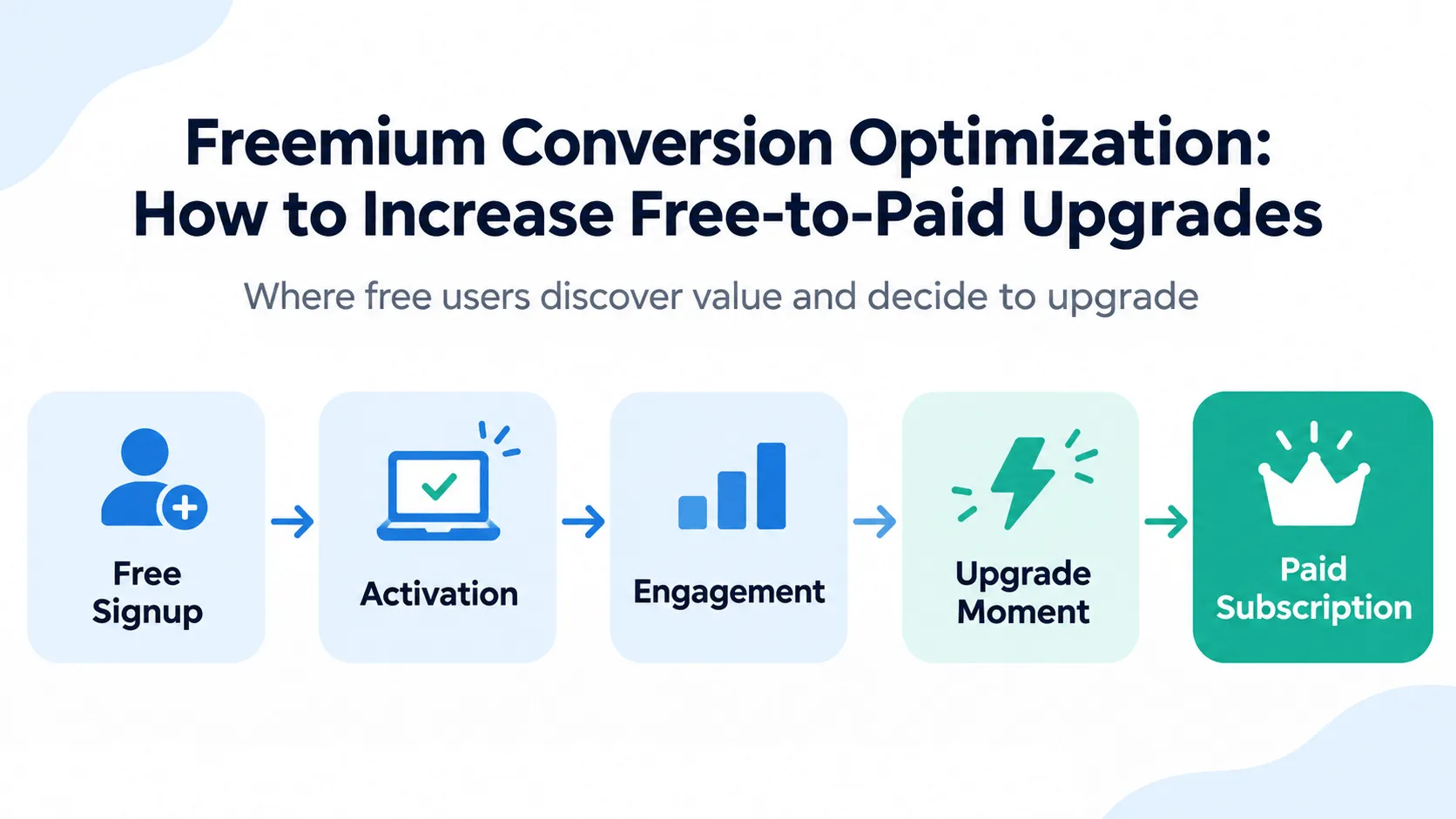
An effective freemium conversion funnel connects five stages: free signup, product activation, repeated engagement, recognition of an upgrade opportunity, and paid subscription.
The goal is to help users experience the product's core value before presenting a relevant reason to pay.
Freemium Conversion Rate: How to Calculate and Track It
The freemium conversion rate measures the percentage of free users who become paying customers within a defined period.
Freemium-to-paid conversion rate = (Free users who upgrade to paid ÷ Total free users in the same cohort) × 100
For example, if 5,000 users sign up for a free plan in January and 200 become paying subscribers within 90 days, the cohort's 90-day conversion rate is 4%.
For reliable measurement, use consistent conversion windows and avoid mixing newly registered users with people who have been using the free product for years.
Other important metrics include:
- Activation rate: Percentage of free users who complete an action indicating that they have experienced the product's core value.
- Upgrade CTA conversion rate: Percentage of users exposed to an upgrade offer who purchase a subscription.
- Time to upgrade: How long users remain on the free plan before subscribing.
- Average revenue per user (ARPU): Revenue generated per user across the defined population, including non-paying users.
- Average revenue per paying user (ARPPU): Revenue generated per paying subscriber.
- Paid subscriber retention: Percentage of subscribers who remain paying customers over a defined period.
Freemium economics also matter: businesses need to balance the cost of supporting free users against revenue generated by paying subscribers.
According to ChartMogul's 2026 SaaS Conversion Report, a 3–5% six-month free-to-paid conversion rate is considered good for self-serve freemium products, while 8–12% represents strong performance.
The study covers primarily B2B software products, so B2C subscription platforms should prioritize their own cohort performance over generalized benchmarks.
7 Freemium Conversion Strategies and Best Practices to Increase Paid Upgrades
1. Identify the Moments When Free Users Are Most Likely to Upgrade
Not every free user is equally likely to purchase a subscription. Some are still exploring the product, while others regularly encounter limitations that prevent them from achieving their goals.
Instead of displaying identical upgrade messages to everyone, analyze how free users interact with the product before becoming paying customers.
Look for behaviors such as:
- Repeatedly accessing premium features.
- Reaching free usage limits.
- Returning to subscription-only content.
- Comparing free and paid plans.
- Increasing product engagement over multiple sessions.
- Attempting to complete actions available only to subscribers.
These behaviors can indicate upgrade moments - situations where the benefits of a paid plan become particularly relevant.
For example, a fitness app might discover that users become more interested in premium coaching after establishing a consistent workout routine.
Analyze event funnels, user segments, and session recordings to identify where upgrade intent appears. Then test subscription prompts at those moments rather than introducing paywalls before users understand the product's value.
2. Place Premium Upgrade Offers Where Users Experience Value
Upgrade opportunities should be visible where users already engage with the product, rather than restricted to a pricing page they may never visit.
A user watching a video, completing a workout, or exploring premium functionality may be more receptive to a relevant subscription offer than someone browsing a general account menu.
Effective placements can include contextual banners, premium content previews, and upgrade buttons near related features.
The message should explain what users gain by subscribing rather than simply asking them to pay.
CRO Experiment: DoYogaWithMe
DoYogaWithMe is an online yoga platform offering free videos alongside premium memberships.
Our behavioral analysis revealed that many users overlooked premium options or found the upgrade process unclear.
We introduced premium subscription banners across high-traffic content pages, including yoga classes, meditation sessions, programs, and account pages. We also redesigned upgrade banners on video pages to make the subscription benefits and next steps clearer.
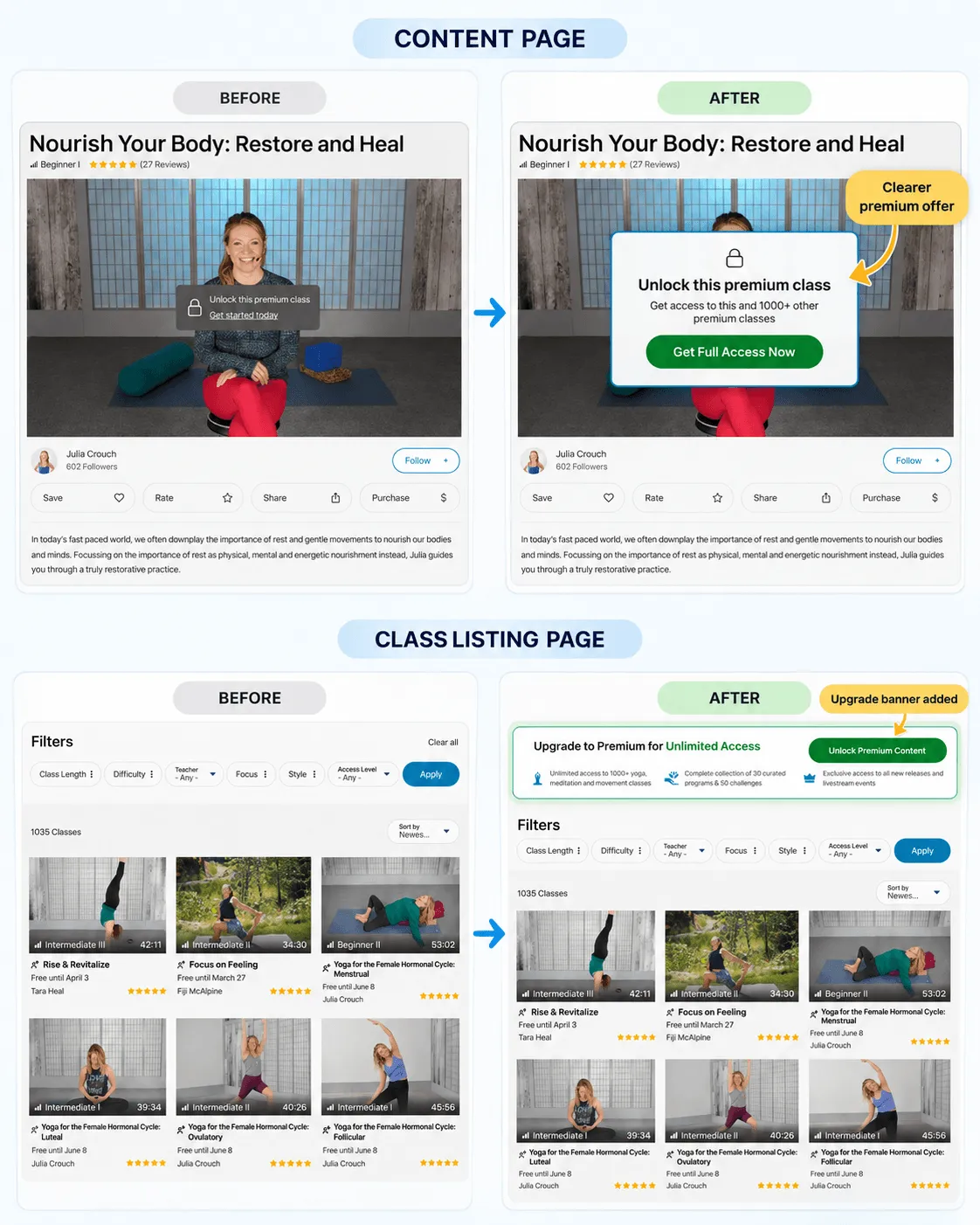
Combined with targeted exit-intent offers, the experiment delivered:
- +173% conversion rate from content page views to paid subscriptions.
- +326% average revenue per user.
These results reflect the combined experiment, rather than banner placement alone.
The takeaway: integrating premium offers into relevant content experiences can create more upgrade opportunities than relying exclusively on a standalone pricing page.
3. Make the Difference Between Free and Paid Plans Clear
A common freemium conversion problem occurs when users cannot easily understand what they receive by upgrading.
If the differences between plans require extensive reading or multiple screens, users may continue using the free version because the additional value is unclear.
An effective subscription comparison should explain which features are included in the free plan, what additional benefits paid tiers provide, and how pricing differs between subscription options.
Prioritize benefits that influence purchasing decisions. Detailed feature lists can remain available for users who want more information.
CRO Experiment: SwingU
SwingU is a golf app offering free functionality alongside paid Plus and Pro memberships.
Our research found that its original subscription comparison did not clearly explain the differences between plans. Pricing and plan selection were also separated across multiple screens.
We redesigned the upgrade experience by combining plan comparison and selection into one screen, displaying prices more clearly, and positioning important premium features higher on the page.
The experiment achieved:
- +14% average revenue per user.
- +13% average revenue per paying user.
- +25% user progression through the upgrade funnel.
The redesigned experience included a seven-day free-trial offer, so these results should not be interpreted as a direct freemium-to-paid conversion uplift.
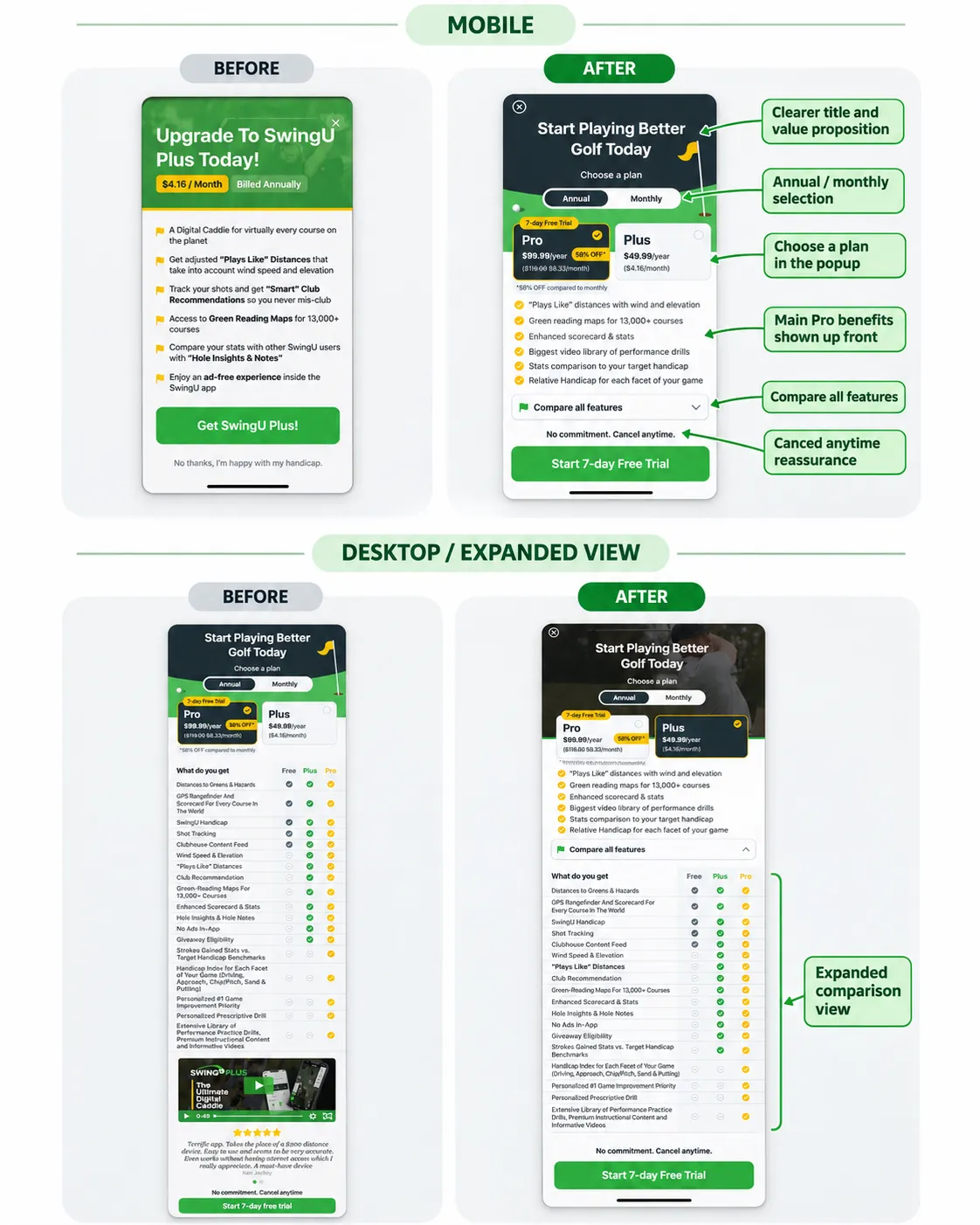
However, the underlying principle applies to freemium products: users need a clear comparison between what they already have and what a paid membership adds.
4. Personalize Premium Messaging Around User Goals
Generic messages such as "Upgrade Now" or "Go Premium" do little to explain why a particular user should subscribe.
More effective freemium conversion tactics connect premium features to the outcomes users want to achieve.
For example, instead of promoting "advanced workout analytics," a fitness app could explain how premium insights help users track progress and improve their training.
To make subscription messaging more compelling, focus on:
- The problems premium functionality solves.
- The outcomes users can achieve with paid features.
- Demonstrations of premium functionality.
- Credible reviews and trust signals that reduce purchasing hesitation.
Related CRO Experiment: CleanMyMac
CleanMyMac, a subscription-based macOS application, experienced hesitation among visitors who lacked a clear understanding of the software's benefits and trustworthiness.
By redesigning the homepage around user problems, product outcomes, and trust indicators, Conversion Rate Store achieved +20% conversion rate and +19% ARPU.
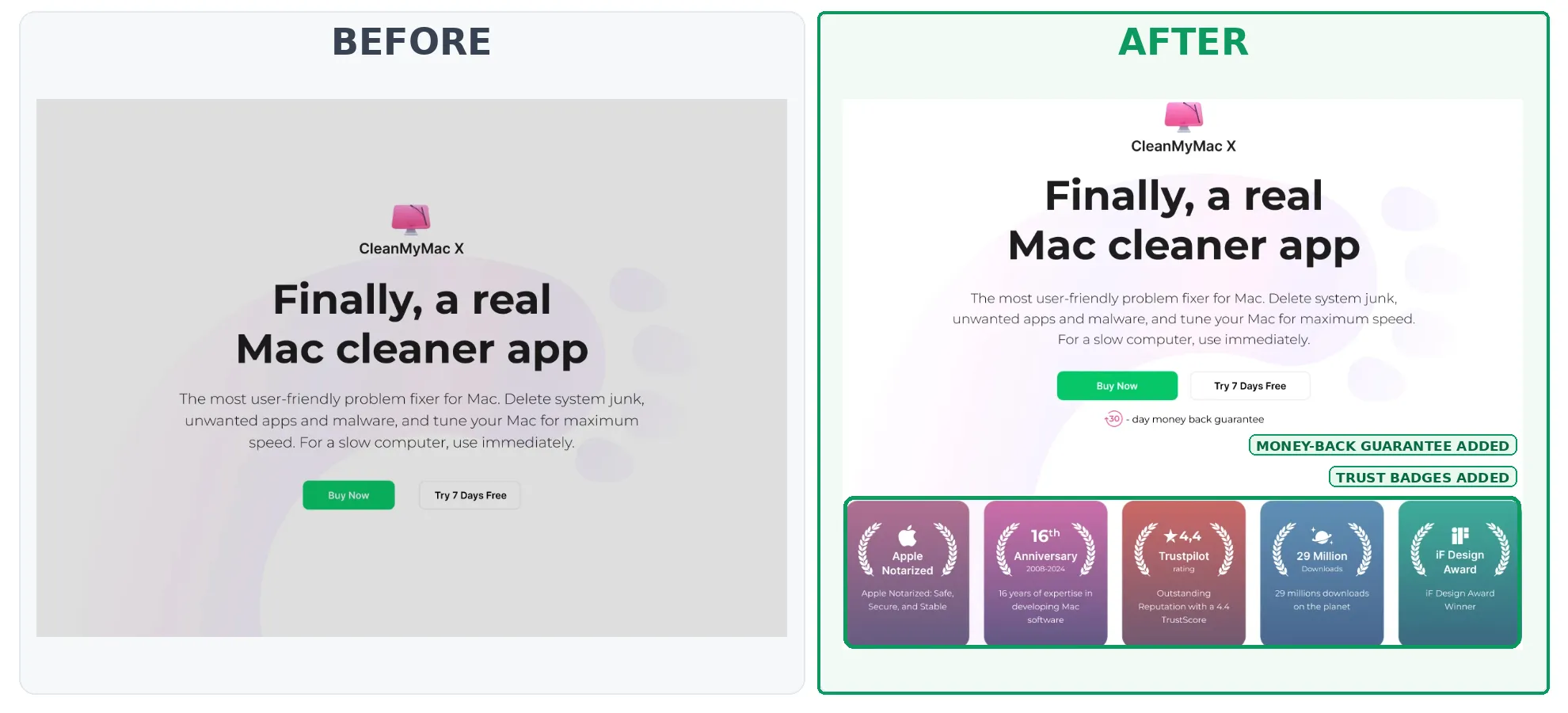
Although this was a subscription acquisition experiment rather than a freemium-to-paid test, it demonstrates the importance of communicating value instead of listing features alone.
5. Reduce Unnecessary Steps in the Upgrade Funnel
Even users who have decided to subscribe may abandon the process when they encounter unnecessary steps, confusing navigation, or repetitive information.
A complicated upgrade funnel introduces friction between the moment users decide to pay and the moment they complete their subscription.
Review the sequence from clicking an upgrade button to selecting a plan and completing payment.
Potential improvements include:
- Combining repetitive upgrade and plan-selection screens.
- Displaying subscription pricing earlier.
- Reducing unnecessary navigation.
- Keeping the selected plan consistent throughout checkout.
- Making mobile payment actions easier to find.
- Explaining subscription terms before payment.
However, reducing the number of screens is not automatically beneficial. Pricing and billing information should remain clear and accessible.
CRO Experiment: SwingU
In a separate SwingU funnel optimization experiment, our team identified unnecessary steps and confusing messages in the membership upgrade journey.
We reduced the process from three screens to two, redesigned the plan comparison interface, and improved the visual hierarchy of subscription benefits.
The experiment resulted in:
- +24% conversion rate.
- +40% average revenue per user.
- +13% average revenue per paying user.
This experiment specifically optimized a free-trial-to-paid membership funnel, rather than measuring direct conversion from a permanent free tier.
Nevertheless, it demonstrates how removing unnecessary friction can improve subscription purchasing decisions, particularly when users have already expressed strong purchase intent.
6. Encourage Annual Subscription Upgrades
For subscription platforms, freemium conversion optimization is not only about increasing the number of paying customers. It can also involve encouraging users to choose plans that generate greater long-term value.
Annual memberships provide more predictable recurring revenue and may reduce the frequency of renewal decisions. However, users need to understand the financial commitment and benefits of choosing an annual plan.
Consider testing clear monthly-versus-annual comparisons, transparent savings calculations, and relevant annual subscription offers for engaged free users.
The goal is to increase subscription value without hiding costs or making alternative plans difficult to select.
CRO Experiment: DoYogaWithMe
The DoYogaWithMe subscription experiment also addressed the platform's preference for annual rather than monthly memberships.
We introduced targeted annual subscription offers and directed eligible free users toward checkout with the annual plan preselected.
Across the combined experiment:
- The annual subscription share increased from 41.67% to 73.46%.
- Average revenue per paying user increased by 56%.
Additional CRO Evidence: SwingU
In the SwingU plan comparison experiment, improving subscription visibility, highlighting annual savings, and simplifying plan selection contributed to a 78% increase in Yearly Pro membership selections.
This result came from the plan redesign discussed in Strategy 3, not a separate experiment. The screen also included a free-trial offer.
Together, these findings show why subscription experiments should evaluate plan selection, ARPU, and ARPPU alongside conversion rates.
7. Test Targeted Exit-Intent Offers Without Disrupting Free Users
Free users who are not ready to subscribe should still be able to enjoy the product.
Excessive pop-ups, repeated interruptions, and aggressive paywalls can undermine the experience that encourages users to remain active.
A more targeted approach is to present relevant subscription offers when users are disengaging or leaving an upgrade-related page.
These offers should be easy to dismiss, relevant to the user's activity, and frequency-capped. On mobile devices, avoid prompts that interrupt tasks requiring concentration.
CRO Experiment: DoYogaWithMe
As part of the DoYogaWithMe experiment, we introduced an exit-intent promotion for logged-in users without an active paid subscription.
The offer encouraged eligible users to choose an annual plan with a savings incentive. Trigger conditions differed between desktop and mobile to reflect user behavior.
The exit-intent pop-up accounted for more than half of new subscriptions during the testing period.
This does not establish the pop-up's isolated incremental impact, but it highlights the potential of reaching users at specific decision points rather than displaying the same promotion continuously.
Common Freemium Conversion Mistakes to Avoid
Even a well-designed freemium model can struggle to generate subscriptions when its upgrade strategy introduces unnecessary friction.
Common mistakes include:
1. Promoting premium too early
Users who have not experienced the product's value may lack a compelling reason to subscribe.
2. Making the free plan too restrictive
If users cannot accomplish a meaningful task, they may abandon the product rather than upgrade.
3. Relying exclusively on upgrade clicks
CTA engagement does not necessarily translate into completed purchases or long-term revenue.
4. Mixing freemium and free-trial results
Permanent free tiers and time-limited trials create different purchasing conditions and should be measured separately.
Conclusion
Freemium conversion optimization works best when businesses understand why users remain on free plans and what motivates them to upgrade.
Targeted improvements to premium messaging, subscription comparisons, and upgrade funnels can increase paid conversions while supporting long-term subscription revenue.
Conversion Rate Store helps B2C SaaS businesses and subscription platforms identify these opportunities through behavioral research, UX optimization, and controlled A/B testing.
Explore our CRO case studies to see how experimentation has improved subscription conversions and revenue across digital products.
Frequently Asked Questions
How Can You Increase Freemium-to-Paid Conversion Rates?
For B2C SaaS businesses, improving freemium-to-paid conversion starts with identifying when free users experience the product's core value and what motivates them to purchase premium features.
An effective SaaS freemium conversion funnel connects activation, repeated engagement, upgrade intent, and paid subscriptions. Fitness apps, educational platforms, and productivity tools can use behavioral analytics to identify high-intent users, introduce premium offers at relevant moments, and simplify subscription purchases.
What Is the Difference Between Freemium and Free-Trial Conversion?
Freemium conversion measures the percentage of users who upgrade from a permanent free tier to a paid subscription, while free-trial conversion measures users who purchase after receiving time-limited access.
Because freemium users can remain free indefinitely, their conversion depends more heavily on ongoing engagement, perceived premium value, and relevant upgrade moments.
Should Freemium Apps Use Paywalls?
Users who regularly engage with the product, encounter meaningful feature limitations, or demonstrate interest in subscription benefits may have stronger upgrade intent.
However, these signals vary by product and should be validated through behavioral analytics and cohort analysis.