
7 Best CRO Agencies in 2026: Comparison, Pricing, Specializations & How to Choose
 Reading time: 20 min
The article presents a list of the best CRO agencies globally, rating each one against objective, transparent criteria that readers can review and assess for themselves.
Those factors can be found online, and they give you an overall view of the performance, efficiency, and specialization the CRO agency provides:
- Number and quality of CRO case studies
- Effective, data-driven CRO process
- A full cross-functional team is required to execute a full-service CRO scope
- Internet-wide sentiment, video testimonials, and industry awards
- Vertical specialization
The article also provides an explanation of the methodology for measuring and assessing the capacity to deliver a full-service CRO scope based on the abovementioned criteria.
It also explains the core services a comprehensive, full-service conversion rate optimization company should provide, and outlines when there is the right time to hire a CRO firm.
At a Glance: The 7 Best CRO Agencies
| Agency | Best For | Key Differentiator |
|---|---|---|
| Conversion Rate Store | Outsourced full-service CRO | Award-winning managed CRO team |
| Conversion | Enterprise experimentation | Large-scale experimentation programs |
| Speero | Experimentation programs | Research + experimentation maturity |
| The Good | eCommerce & SaaS | Research + UX + testing + implementation |
| Conversionista! | CRO maturity & experimentation culture | Building internal experimentation capabilities |
| Conversion Rate Experts | Research-led full-service CRO | CRE Methodology™ + extensive CRO experience |
| KlientBoost | PPC + CRO | Paid acquisition + landing-page optimization |
Editorial disclosure
How We Evaluated the CRO Agencies
Scoring an agency’s capacity to deliver a full-service CRO scope is a multi-dimensional question - no single metric captures it. We use a weighted scoring framework that evaluates five dimensions and converts them into one comparable score from 0 to 100.
Each agency is scored from 0 to 5 across five dimensions:
1. Case Studies (CS) — 25%
Rewards published case studies with named clients and specific, measurable results. For example, 5/5 = 25+ recent case studies with named clients and measurable outcomes.
2. Process Rigor (PR) — 25%
Evaluates how clearly an agency documents its CRO methodology, research process, experimentation framework, and approach to evidence-based optimization. More comprehensive and clearly documented methodologies receive higher scores.
3. Team Coverage (TC) — 15%
Evaluates whether the agency demonstrates the cross-functional capabilities required for full-funnel CRO, including analytics, UX research, strategy, design, copywriting, development, QA, and project management.
4. Sentiment & Social Proof (SP) — 20%
Combines independent client reviews, video testimonials with named clients, and relevant industry recognition and awards.
5. Vertical Specialization (VS) — 15%
Rewards demonstrable experience and expertise in the industries and business models relevant to the agency’s target clients.
Scoring Method
Each dimension is scored from 0 to 5 and weighted according to its importance:
Capacity (0–5) = 0.25 × CS + 0.25 × PR + 0.15 × TC + 0.20 × SP + 0.15 × VS
The resulting score is then multiplied by 20:
Capacity (0–100) = Capacity (0–5) × 20
For each dimension, scores are based on documented evidence rather than subjective impressions.
For example, the Case Studies score follows this scale:
- 5/5: 25+ recent case studies with named clients and measurable outcomes
- 4/5: 15–24
- 3/5: 8–14
- 2/5: 3–7
- 1/5: Fewer than 3
- 0/5: No relevant published evidence
The same evidence-based principle is applied to the other four dimensions using their respective criteria.
This framework allows agencies with different strengths to be compared using the same methodology. A high score can be achieved through different combinations of strengths - for example, strong case-study evidence, rigorous methodology, extensive social proof, broad team capabilities, or deep expertise in a specific vertical.
The List of the Top Conversion Rate Optimization Agencies
The table below summarizes the top-rated conversion rate optimization firms featured in this article:
| Agency | Сase Studies | Process Rigor | Team Coverage | Sentiment and Social Proof | Vertical Specialization | Score/5 | Total |
|---|---|---|---|---|---|---|---|
| Conversion Rate Store | 5 | 4 | 4 | 5 | 4 | 4.45 | 89 |
| Conversion | 5 | 5 | 4 | 3 | 5 | 4.45 | 89 |
| KlientBoost | 5 | 4 | 4 | 5 | 4 | 4.45 | 89 |
| The Good | 5 | 4 | 3 | 4 | 4 | 4.10 | 82 |
| Conversion Rate Experts | 5 | 4 | 2 | 3 | 4 | 3.75 | 75 |
| Speero | 3 | 5 | 3 | 3 | 4 | 3.65 | 73 |
| Conversionista! | 3 | 3 | 3 | 2 | 4 | 2.95 | 59 |
1. Conversion Rate Store
Best for
Companies looking for an award-winning, fully outsourced CRO team to manage research, strategy, design, experimentation, and implementation.
Overview
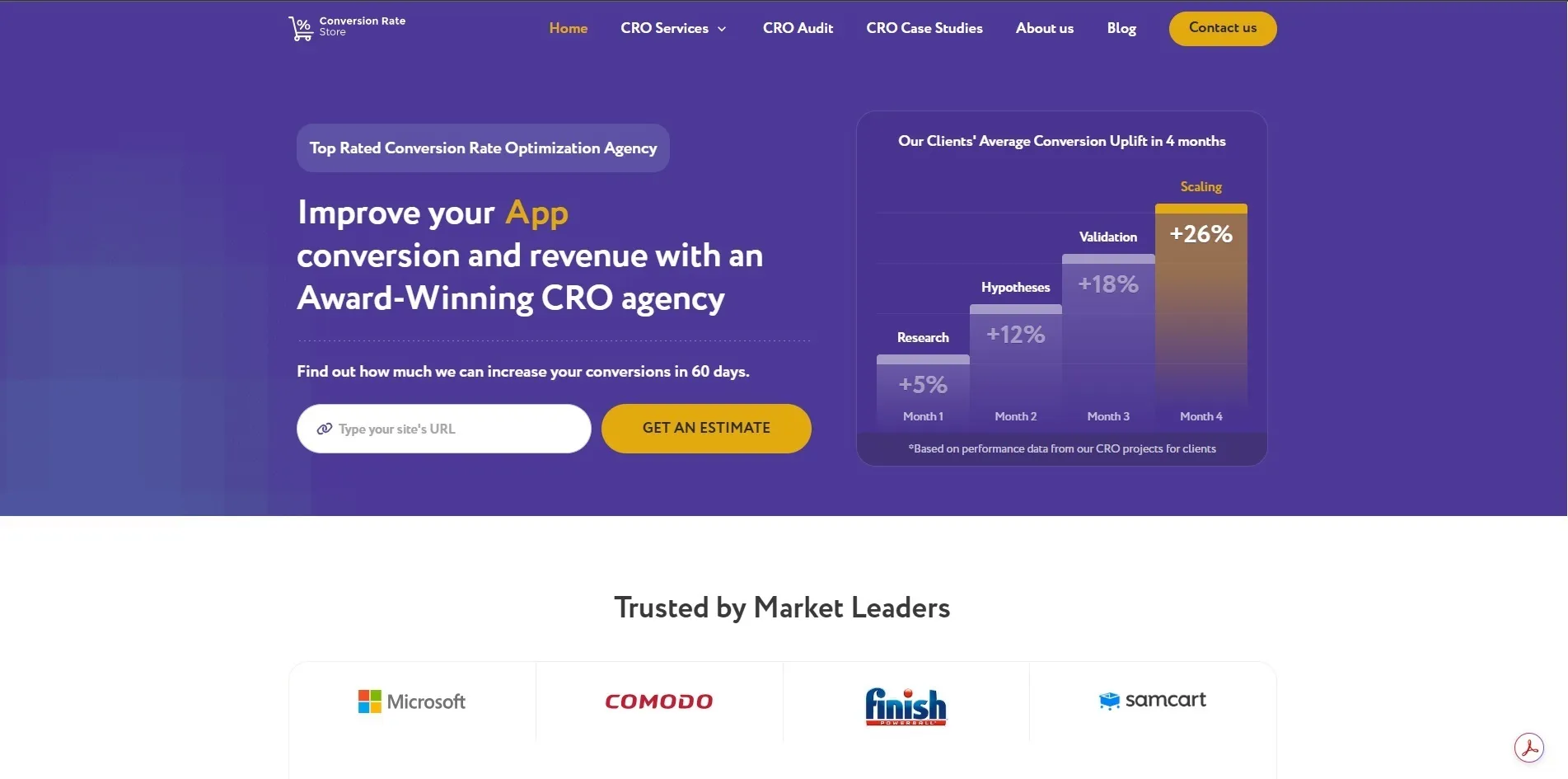
Conversion Rate Store is an award-winning CRO agency focused on fully managed conversion rate optimization for medium-sized and large businesses. The agency provides an outsourced CRO team covering the full optimization cycle, from funnel analytics and behavioral research to hypothesis development, UX/UI design, A/B testing, validation, and implementation.
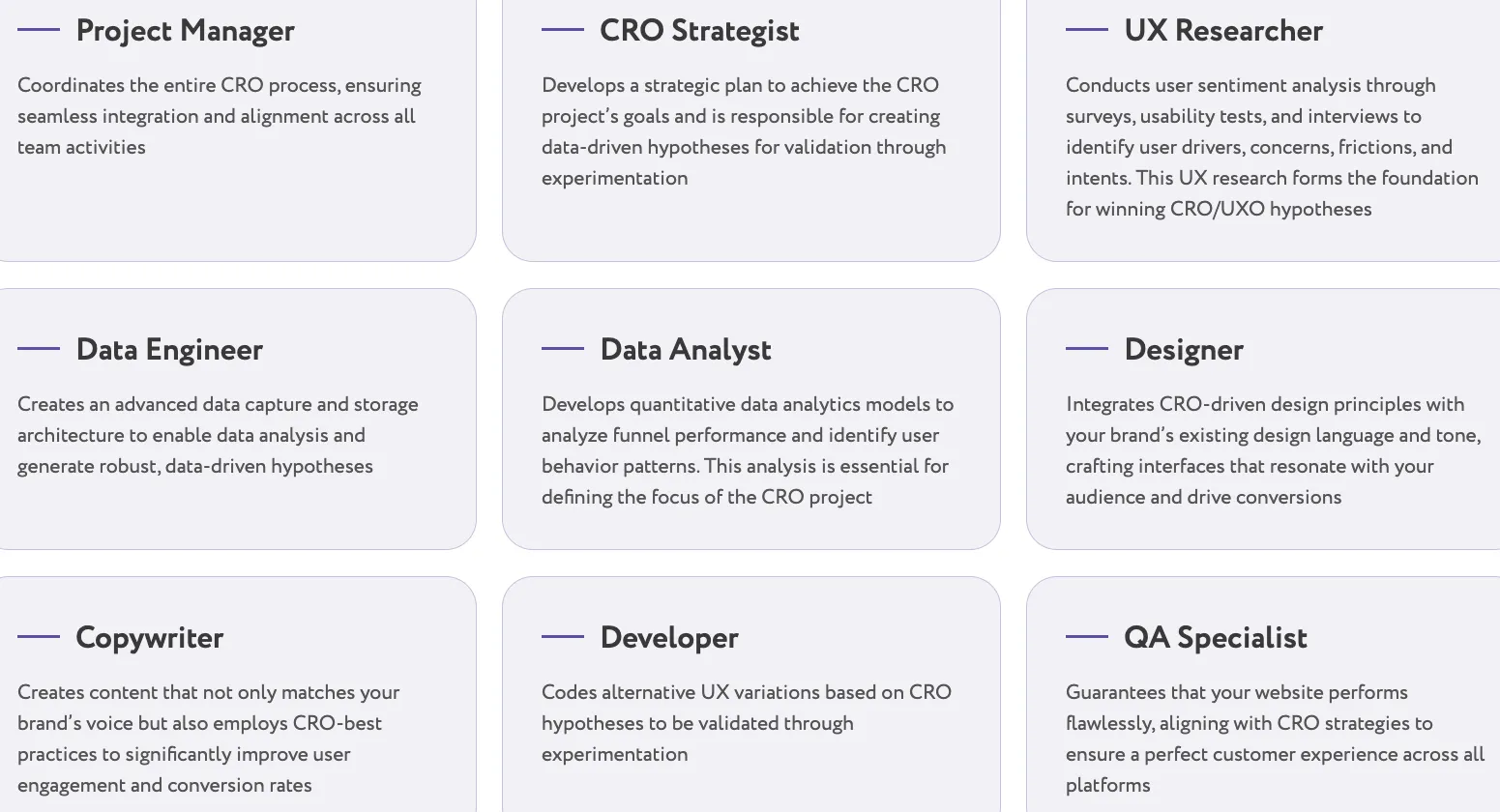
The agency's published methodology includes funnel tracking, user-behavior analysis, behavioral pattern identification, qualitative research, UX research, design, experimentation, QA, and post-test analysis. Its website currently lists 28 CRO case studies, including 11 eCommerce, 6 marketplace, 4 LeadGen, 3 B2C SaaS, 2 B2B SaaS, and 2 mobile-app cases.
Conversion Rate Store has also been recognized as CRO Agency of the Year 2024 by European Agency Awards and has received additional industry recognition, including Clutch recognition and Experimentation Elite nominations.
Pricing: Custom pricing.
Conversion Rate Store does not position its core service as performance-based pricing. Instead, it provides a fully outsourced CRO engagement with a dedicated multidisciplinary team.
Results
Conversion Rate Store publishes measurable results across its CRO case studies.
Examples include:
- +173% conversion rate for DoYogaWithMe (B2C SaaS)
- +81% conversion rate for Localizer (B2B SaaS)
- +56% conversion rate for GrantMe (LeadGen)
- +17% conversion rate for Preply (Marketplace)
Evidence
- 28 published CRO case studies
- 40 verified reviews listed on the agency's contact page
- Finalist CRO Agency of the Year 2026 — European Agency Awards
- Named clients include Microsoft, Comodo, SamCart, Preply, CleanMyMac, and Papaya Global
Pros/cons
Pros
- Award-winning CRO agency
- Fully outsourced CRO team
- 28 published CRO case studies
- Experience across eCommerce, SaaS, marketplaces, LeadGen, and mobile apps
- Research, strategy, UX, design, development, experimentation, and QA under one engagement
- Experience with medium and large businesses
Cons
- Best suited to companies with sufficient traffic and conversion volume to support systematic experimentation
- Custom engagement rather than publicly listed pricing
- More comprehensive than needed for companies looking for a one-off UX audit or isolated A/B test
Sсore
- Case studies (CS): 5
- Process rigor (PR): 4
- Team coverage (TC): 4
- Sentiment & social proof (SP): 5
- Vertical specialization (VS): 4
2. Conversion
Best for
Enterprise companies and growing organizations that want to build or scale a structured experimentation program.
Overview
Conversion is a dedicated CRO and experimentation agency formed through the integration of Conversion.com and WiderFunnel. Its offering covers conversion rate optimization, enterprise experimentation consulting, product and pricing experimentation, personalization, conversion-centered design, user research, and competitor benchmarking.
The agency uses a mixed-methods approach combining UX research with A/B testing and has developed proprietary experimentation frameworks, including the Infinity Experimentation Process. Conversion says its work has generated more than $2 billion in additional revenue for clients.
Pricing: Custom pricing.
Results
Public case studies include:
- £2.8 million additional annual revenue for Clarks from the first experiment
- 46% revenue increase and 2x sales for Wistia
- 18x ROI for Gousto
- More than 30x ROI for thortful
Evidence
Conversion publishes case studies across eCommerce, SaaS, finance, retail, travel, education, and other industries.
Pros/cons
Pros
- Dedicated CRO and experimentation specialization
- Strong enterprise experience
- Full-service experimentation
- Product and pricing experimentation
- Large specialist team
- Extensive case-study library
Cons
- Pricing is not publicly disclosed
- Enterprise-oriented programs may be more than smaller companies need
- Experimentation programs generally require sufficient traffic, analytics, and organizational support
Sсore
- Case studies (CS): 5
- Process rigor (PR): 5
- Team coverage (TC): 4
- Sentiment & social proof (SP): 3
- Vertical specialization (VS): 5
3. KlientBoost
Best for
B2B and eCommerce companies that want to combine paid acquisition with landing-page and conversion optimization.
Overview
KlientBoost is a performance marketing agency with CRO capabilities closely integrated with paid acquisition. Its model is particularly relevant to companies where landing-page conversion and paid-media efficiency need to be optimized together.
Its CRO approach includes A/B testing, funnel analysis, landing-page optimization, and revenue-focused experimentation.
Pricing: Custom pricing.
Results
KlientBoost publishes CRO and paid-media success stories across B2B and eCommerce. Its positioning is particularly relevant for businesses where improving the conversion rate of paid traffic is a major growth opportunity.
Evidence
The agency has a long-standing focus on PPC, landing pages, and conversion optimization and has built a large ecosystem of CRO educational content and case studies.
Pros/cons
Pros
- Strong PPC + CRO combination
- eCommerce and B2B experience
- Landing-page optimization
- Conversion-focused paid acquisition
- Large content and case-study ecosystem
Cons
- CRO is closely connected to its broader performance marketing offering
- Less suitable for companies looking exclusively for a dedicated experimentation consultancy
- Pricing is not publicly disclosed
Score
- Case studies (CS): 5
- Process rigor (PR): 4
- Team coverage (TC): 4
- Sentiment & social proof (SP): 5
- Vertical specialisation (VS): 4
4. The Good
Best for
eCommerce and SaaS companies looking for research-led digital experience optimization.
Overview
The Good is a specialized optimization consultancy rather than a generalist digital agency. Founded in 2009, it has more than 15 years of experience in conversion optimization, research, and strategy and formally developed its Digital Experience Optimization approach in 2024.
Its approach combines research, testing, UX, strategy, and implementation. The company describes its Digital Experience Optimization Program as a custom solution designed around the specific problems preventing users from progressing through a digital journey.
Pricing: Custom pricing.
Results
The Good reports hundreds of millions of dollars in additional revenue generated for clients and an average 16:1 ROI for its optimization work.
Evidence
The company publishes research, optimization resources, case studies, and industry expertise and works primarily with eCommerce and product marketing organizations.
Pros/cons
Pros
- Strong eCommerce expertise
- Research-first approach
- UX and conversion strategy
- Testing and implementation
- More than 15 years of optimization experience
- Strong thought leadership and educational content
Cons
- High investment level
- Less suitable for small businesses with limited CRO budgets
- Custom programs require meaningful internal commitment
Score
- Case studies (CS): 5
- Process rigor (PR): 4
- Team coverage (TC): 3
- Sentiment & social proof (SP): 4
- Vertical specialization (VS): 4
5. Conversion Rate Experts
Best for
Established businesses looking for research-led, full-service CRO backed by extensive experimentation experience.
Overview
Conversion Rate Experts (CRE) is a long-established CRO consultancy with experience across B2B, B2C, eCommerce, SaaS, financial services, travel, media, and other industries.
The company says it has helped clients in 41 countries and 11 languages, including Amazon, Apple, Google, Facebook, and Dropbox. It uses its proprietary CRE Methodology™, which covers traffic analysis, visitor research, market intelligence, opportunity identification, experimental strategy, page design, experimentation, and scaling successful campaigns.
Pricing: Custom pricing.
Results
CRE publishes more than 109 testimonials and success stories. Its public examples include significant revenue and sales improvements across different businesses.
The company also reports experience with hundreds of businesses across more than 80 verticals.
Evidence
- CRE Methodology™ documented publicly
- Clients in 41 countries and 11 languages
- Clients include Amazon, Apple, Google, Facebook, and Dropbox
- Two Queen's Awards for Enterprise are cited by the company
Pros/cons
Pros
- Extensive CRO experience
- Proprietary research-led methodology
- Broad industry coverage
- Strong enterprise experience
- Large library of client results and testimonials
- Experience across 41 countries and 11 languages
Cons
- Pricing is not publicly disclosed
- Its broad experience means buyers should still validate specific vertical and business-model fit
- Client testimonials represent individual engagements and should not be treated as typical results
Score
- Case studies (CS): 5
- Process rigor (PR): 4
- Team coverage (TC): 2
- Sentiment & social proof (SP): 3
- Vertical specialisation (VS): 4
6. Speero
Best for
Companies that want to establish a mature experimentation program and build a culture of data-driven decision-making.
Overview
Speero is a research-heavy CRO and experimentation agency that combines customer research, analytics, experimentation, UX, strategy, and experimentation program development.
Its offering includes full-service experimentation programs, conversion rate optimization, customer experience optimization, experimentation maturity audits, research, UX strategy, analytics audits, and data services.
Speero's positioning is particularly relevant for organizations that want to move beyond individual A/B tests and develop a repeatable experimentation operating system.
Pricing: Custom pricing.
Results
Public case studies include:
- Helping MongoDB scale from 0 to 100 experiments per year in six months
- $1.5 million in additional revenue for Procter & Gamble
- $2 million additional annual revenue from a research-backed recommendation for RevZilla
Evidence
Speero states that it has more than 10 years of successful case studies and publishes examples across B2B, SaaS, eCommerce, DTC, LeadGen, and retail.
Pros/cons
Pros
- Strong research and experimentation focus
- Experimentation maturity expertise
- SaaS, eCommerce, B2B, DTC, and LeadGen experience
- Research + analytics + experimentation under one framework
- Strong educational and thought-leadership presence
Cons
- Best suited to organizations willing to invest in experimentation maturity
- Pricing is not publicly disclosed
- Companies without sufficient traffic, analytics, or internal support may need foundational work before a high-velocity program can operate effectively
Score
- Case studies (CS): 3
- Process rigor (PR): 5
- Team coverage (TC): 3
- Sentiment & social proof (SP): 3
- Vertical specialization (VS): 4
7. Conversionista!
Best for
Organizations that want to improve CRO maturity and build a sustainable experimentation culture.
Overview
Conversionista! is a Nordic growth and experimentation consultancy founded in 2010. The company says it has more than 80 specialists across five offices and more than 1,000 collaborations with Scandinavian and European brands.
Its approach combines data, research, experimentation, UX, analytics, and organizational enablement. Rather than focusing only on individual tests, Conversionista! works with client teams to develop the capabilities and processes needed for sustainable experimentation.
Pricing: Custom pricing.
Results
A recent Bygghemma case study reports:
- 21 prioritized experiments
- 10 generated hypotheses
- 4.82% conversion-rate uplift
- +53 MSEK revenue uplift
Evidence
Conversionista! says it has worked with more than 1,000 Scandinavian and European brands and has more than 80 specialists across five offices.
Pros/cons
Pros
- Strong experimentation maturity focus
- Nordic and European enterprise experience
- Cross-functional growth teams
- Research + analytics + UX + experimentation
- Strong emphasis on knowledge transfer
Cons
- Pricing is not publicly disclosed
- Particularly strong Nordic positioning
- More appropriate for organizations looking to build experimentation capabilities than companies seeking a simple one-off CRO audit
Score
- Case studies (CS): 3
- Process rigor (PR): 3
- Team coverage (TC): 3
- Sentiment & social proof (SP): 2
- Vertical specialisation (VS): 4
Best CRO Agencies by Industry & Business Type
The best CRO agency depends heavily on the business model, traffic volume, experimentation maturity, and type of conversion funnel.
1. Best CRO agencies for eCommerce
Conversion Rate Store, Conversion, and Splitbase
These agencies have strong experience with product discovery, landing pages, purchase funnels, checkout experiences, and revenue-focused experimentation.
2. Best CRO agencies for SaaS
Conversion Rate Store, Speero, Conversion, and Conversion Rate Experts
SaaS companies typically benefit from agencies experienced in acquisition funnels, pricing pages, trial-to-paid conversion, onboarding, and experimentation.
3. Best CRO agencies for B2B
Conversion Rate Store, KlientBoost, Conversion, and Speero
For B2B, the strongest programs typically optimize not just form completion but lead quality, qualification, messaging, and the complete path from acquisition to sales opportunity.
Conversion Rate Store's Comodo case study demonstrates this approach. The B2B cybersecurity landing page was redesigned around pain-driven copy, simplified messaging, and a clearer lead-generation journey, producing a reported 17.5% conversion rate uplift.
4. Best CRO agencies for Enterprise
Conversion, Speero, Conversion Rate Store, and Conversion Rate Experts
Enterprise CRO requires more than A/B testing. It often involves experimentation governance, cross-functional collaboration, analytics infrastructure, research, and organizational change.
5. Best CRO agencies for Finance & Fintech
Conversion Rate Store, Conversion, Speero, and Conversion Rate Experts
Finance and fintech companies typically benefit from CRO agencies experienced in complex conversion funnels, trust-sensitive user journeys, lead generation, onboarding, pricing, and subscription or application flows.
Conversion Rate Store has documented finance CRO experiments with MoneyGeek, including a 13% uplift in quote comparison conversions from improving access to high-intent insurance resources. A separate experiment using geo-based form prefill produced an 11% increase in conversion rate to quote.
6. Best CRO agencies for Mobile Apps
Conversion Rate Store, Conversion, and Moburst
For mobile apps, CRO programs can focus on onboarding, registration, subscription conversion, upgrade flows, in-app purchases, retention, and user activation.
Conversion Rate Store's SwingU mobile app case study shows how subscription funnel optimization can affect both conversion and monetization. Streamlining the free-to-paid upgrade flow produced a reported 24% conversion rate uplift and 40% increase in average revenue per user.
7. Best CRO agencies for Healthcare
Conversion, Conversion Rate Store, and Conversion Rate Experts
Healthcare CRO requires particular attention to trust, clarity, accessibility, patient journeys, lead generation, appointment booking, and compliance-sensitive user experiences.
Conversion Rate Store has also documented CRO work in health and wellness, including SomniFix and NATPAT. Reported experiments include a 23% conversion rate uplift for SomniFix after improving its value proposition and addressing informational gaps in the customer journey.
8. Best CRO agencies for Travel
Conversion, The Good, and Conversion Rate Experts
Travel companies typically benefit from CRO programs focused on search and discovery, booking funnels, pricing presentation, trust signals, checkout, personalization, and reducing friction throughout the customer journey.
Why Is It Important to Pick the Right CRO Agency?
Choosing a CRO agency is not simply about finding a company that can run A/B tests. A mature CRO partner becomes an extension of your product, marketing, analytics, and growth teams.
The right agency should be able to identify where users encounter friction, understand why those problems occur, turn evidence into testable hypotheses, and validate solutions through controlled experimentation.
The wrong partner can produce attractive redesigns or generic UX recommendations without proving whether those changes actually improve business outcomes.
A data-driven CRO approach treats meaningful UX/UI and copy changes as hypotheses rather than final solutions. Instead of implementing a large redesign based primarily on expert opinion or general best practices, proposed changes are informed by quantitative and qualitative research and validated through controlled experimentation before they are rolled out more broadly.
A strong CRO engagement should therefore connect user behavior and research with measurable business metrics such as conversion rate, revenue per user, average order value, qualified leads, customer acquisition cost, or lifetime value.
The goal is not simply to generate more experiments. It is to create a repeatable process that produces better decisions and measurable improvements over time.
What Are the Criteria for Choosing a CRO Agency?
It is essential to apply objective and transparent selection criteria when choosing a CRO agency in order to minimize bias and subjective judgment. The following are, in our view, the most objective and transparent criteria for selecting a CRO firm as your outsourced conversion optimization partner.
1. Case studies
A CRO agency must demonstrate its competence and expertise through recent, verifiable case studies showing the creation and validation of data-driven hypotheses that produced a meaningful, measurable, and commercially relevant impact on key business metrics such as conversion rate, average order value, revenue per user, and customer acquisition cost.
Look for named clients, measurable outcomes, clear hypotheses, and an explanation of how experiments were designed and validated.
2. Data-driven CRO methodology
A skilled CRO agency should be able to clearly explain how it moves from data and research to hypotheses, UX/UI and copy solutions, experimentation, and post-test analysis.
A rigorous CRO program should combine quantitative and qualitative research rather than relying primarily on UX best practices or subjective design decisions.
Depending on the product and funnel, this can include:
- analytics and tracking audits,
- funnel and cohort analysis,
- user-flow analysis,
- behavioral analytics and session recordings,
- customer interviews and surveys,
- usability testing,
- competitor research,
- conversion-barrier analysis.
These insights should be converted into prioritized hypotheses and alternative UX/UI or copy solutions. Proposed changes are then validated through controlled experimentation before broader implementation, with experiment results feeding the next iteration of research and testing.
When comparing realiable CRO agencies, look for evidence that this process is repeatable and embedded in their methodology. A data-driven CRO agency should be able to explain what evidence supports each hypothesis, how experiments are prioritized, and how results are tied to measurable business outcomes. The agency should be able to clearly explain how it moves from data and research to hypotheses, design, experimentation, and analysis.
3. Team capabilities
A full-service CRO program normally requires analytics, research, strategy, UX/UI, copywriting, development, QA, and project management capabilities.
To execute a full-service CRO program effectively, a CRO firm needs a coordinated cross-functional team covering the core competencies required for research, experimentation, and implementation.
| Role | Primary Responsibility |
|---|---|
| Data Engineer | Data tracking architecture and user journey tracking |
| Data Analyst | Quantitative data and funnel analysis |
| UX Researcher | Qualitative research and user behavior |
| CRO Strategist | Insights, hypotheses, and prioritization |
| Designer | UX/UI and experiment design |
| Copywriter | Messaging and conversion-focused content |
| Developer | Experiment implementation |
| QA | Experiment validation and quality assurance |
| Project Manager | Coordination and delivery |
These are not optional supporting roles. They are the core competencies required to deliver a comprehensive outsourced CRO engagement at a high standard.
4. Business-model fit
It is important to assess the depth of expertise and experience an agency has in the specific vertical in which the client operates. For example, our agency focuses on eCommerce, SaaS, apps, and lead-generation funnels. Some agencies specialize even more narrowly, concentrating on a single vertical and, as a result, developing particularly strong domain expertise within it.
Therefore, when selecting a CRO agency, you should evaluate how deep its knowledge, practical experience, and strategic understanding are within your category. The goal is to identify a partner with sufficient vertical expertise to understand the economics, user behavior, decision-making patterns, and funnel dynamics specific to your market.
5. Evidence and reviews
Look for independent reviews, named client testimonials, awards, and verifiable case studies rather than relying exclusively on agency claims.
6. Engagement model
Understand whether the agency offers audits, projects, retainers, full-service CRO, experimentation consulting, or another engagement structure.
How much does a CRO agency cost?
CRO agency pricing varies widely depending on scope, seniority, and market positioning.
As a general benchmark:
- Boutique or early-stage agencies typically charge $3,000–$8,000 per month.
- Mid-market agencies with full cross-functional teams range from $8,000–$15,000 per month.
- Enterprise-grade programs — including data engineering, full UX research, design, development, and QA — can exceed $20,000 per month.
Some agencies offer performance-based pricing, taking a percentage of measured revenue lift instead of a flat retainer.
Project-based engagements (audits, sprint programs) typically start at $5,000–$15,000.
For a detailed breakdown by engagement type, see our CRO pricing guide.
5 Red Flags When Choosing a CRO Agency
1. Guaranteed huge uplift without qualification
No agency can responsibly guarantee a specific conversion increase without understanding traffic, funnel economics, users, and experimentation constraints.
2. No documented methodology
If an agency cannot explain how it moves from research to hypothesis and experimentation, ask how its recommendations are validated.
3. Generic UX recommendations without research
Recommendations such as “add a sticky CTA” or “change the button color” are not a substitute for evidence-based CRO.
4. No named case studies
Be cautious when an agency cannot provide verifiable examples of its previous work.
At Conversion Rate Store, for example, we have 28 CRO case studies, which represent one of the largest public case-study libraries among specialist CRO agencies.
5. No explanation of experimentation methodology
A credible CRO partner should be able to explain how experiments are designed, implemented, QA-tested, and analyzed.
Alternatives to Сonversion Rate Optimization Companies
Working with a specialized CRO agency is not the only path to better conversion performance. Depending on budget, traffic volume, and internal capacity, one of the following three approaches may be a better fit.
1. Hiring an Independent CRO Consultant
For companies with limited budgets or traffic that is too low to justify a full agency retainer, an independent consultant can provide strategic guidance and hands-on execution at a materially lower cost.
Consultants typically bill $150–$300 per hour, well below agency retainer economics, and many bring experience gained inside top agencies, which means they can help a business avoid the most common CRO mistakes without the overhead of a full team.
Pros
Lower cost than an agency, flexible engagement terms, and direct access to senior-level expertise without layers of account management.
Cons
A single consultant has limited bandwidth compared to a full cross-functional team, and typically lacks the resources for complex technical implementation — data engineering, design, and development still need to happen somewhere. In most cases, the client's internal team ends up executing the recommendations, which means this route only works if that internal capacity already exists.
For a deeper look at when this route makes sense and how to vet a consultant, see our guide to hiring a CRO consultant.
2. Building an In-House CRO Team
Organizations committed to a long-term optimization program often build internal teams that combine research, design, analytics, and development under one roof.
Pros
Deep institutional knowledge of the product and customer base, tight alignment with company goals, and cumulative learning that compounds inside the organization rather than leaving with an outside vendor. In-house teams can also move quickly on opportunities and embed optimization thinking across departments rather than treating it as an external function.
Cons
The investment required to hire, train, and retain specialized talent is significant. A genuinely complete team — covering data engineering, analytics, UX research, strategy, design, copywriting, development, and QA — typically exceeds $500,000 annually in fully-loaded compensation for a mid-sized program.
Without agency-level breadth of experience and an outside perspective, in-house teams can also plateau or settle into pattern thinking, running the same category of test repeatedly rather than continually challenging their own assumptions.
3. Using Self-Serve CRO Tools and Software
For teams not yet ready to commit to either a consultant or a full internal build, self-serve platforms — analytics, heatmaps, session recording, and A/B testing tools — offer a lower-cost way to start gathering behavioral data and running basic experiments.
Pros
Low upfront cost relative to hiring, fast setup, and enough functionality to validate simple hypotheses without outside help.
Cons
Software alone doesn't replace the research, prioritization, and experimentation methodology that turns raw data into a validated CRO program — someone on the team still has to interpret the data, form hypotheses, and design statistically sound tests, which is exactly the layer most self-serve tools don't provide. For a full breakdown of the category, see our guide to the best CRO tools and software.
Each of these paths can work — the right choice depends on how much internal capacity already exists and how quickly measurable results are needed.
Final Thoughts
There is no single best CRO agency for every company.
Choosing the right CRO partner is ultimately about matching capacity to context. The agencies ranked highest in this guide each demonstrate an experimentation-first approach:
- a documented methodology,
- a complete cross-functional team,
- verifiable case studies with measurable revenue-focused optimization outcomes,
- credible sentiment signals.
The Capacity score makes the comparison reproducible, but it is a starting point rather than a verdict — a buyer with strong vertical specificity, a particular budget profile, or a specific testing program in mind should weigh the dimensions accordingly and use this guide as a transparent framework for their own evaluation.
The strongest signal of agency competence remains constant regardless of score: a research-based approach that converts analytics insights into prioritized hypotheses, validates them through structured experimentation, and ties every test directly to revenue growth and a lower customer acquisition cost.
That is what separates a real CRO partner from a superficial vendor.
FAQ
What services do the best conversion rate optimization companies offer?
A full-service CRO scope spans A/B testing, multivariate testing, landing page optimization, UX design, conversion research, customer journey mapping, usability testing, personalization, and ongoing conversion audit work - all anchored in a documented CRO strategy and a coherent conversion framework.
These pillars are not theoretical. McKinsey research finds that personalization typically drives a 10-15% revenue lift, and that companies excelling at it generate up to 40% more revenue from those activities than average peers — making CRO a core growth lever rather than a marginal optimization.
What does a rigorous CRO program include?
A rigorous CRO program is an ongoing process that combines research, prioritization, experimentation, and implementation rather than a series of disconnected A/B tests.
It typically includes:
- analytics and tracking validation,
- funnel and behavioral analysis,
- customer and UX research,
- conversion-barrier identification,
- hypothesis development and prioritization,
- UX/UI and copy design,
- experiment development and QA,
- A/B testing,
- statistical analysis,
- post-test evaluation.
The strongest CRO programs follow a proven, repeatable methodology, continuously feeding experiment results back into the research process and creating an optimization cycle rather than relying on one-time audits or isolated redesigns.
How do CRO agencies decide what to test first?
Rigorous CRO agencies use a structured prioritization framework rather than intuition or generic best practices. The starting point is always data:
- quantitative analysis of funnel drop-offs (where are users leaving, and at what rate)
- behavioral analysis (what are high-converting users doing differently)
- qualitative research (what frictions, doubts, or unmet expectations are users reporting).
From this body of evidence, hypotheses are generated and then scored against a prioritization matrix - typically weighting commercial impact, statistical feasibility (traffic volume available), implementation effort, and strength of the underlying evidence.
The highest-scoring hypotheses enter the experiment backlog first. This ensures every test is grounded in research rather than stakeholder preferences.
How do I measure whether a CRO agency is actually delivering results?
The primary KPIs for a CRO engagement are:
- conversion rate (the macro conversion relevant to your business)
- revenue per session
- revenue per user
- average order value.
Beyond these, meaningful secondary metrics include specific funnel step completion rates, engagement depth, and user cohort behavior aligned with the hypothesis being tested.
A credible CRO agency should provide transparent reporting on experiment results — including statistical significance, confidence intervals, and the business impact of each validated win.
Watch for agencies that report only percentage lifts without statistical context: a 15% lift from an underpowered test with 60% confidence is not a real win.
Trusted agencies also conduct post-test segmentation to understand which user cohorts responded most strongly, informing personalization strategy.